29 Αυγούστου, 2026
Άρθρα και γνώμες
· Άρθρα με άποψη
· Τελευταία νέα

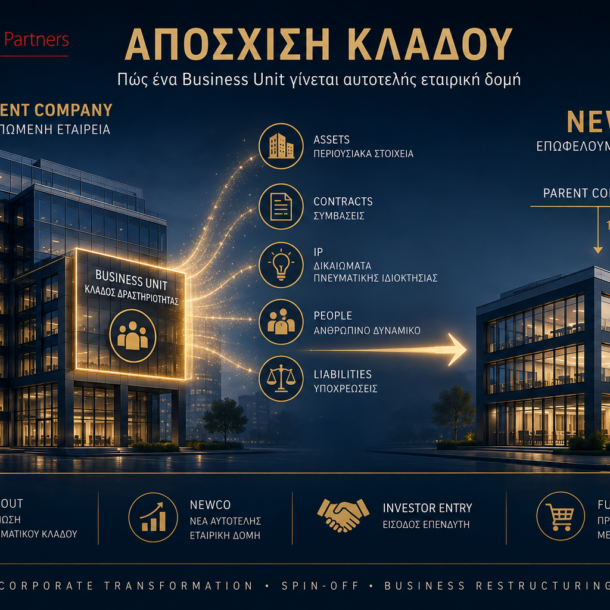
Η μερική διάσπαση και η απόσχιση κλάδου επιτρέπουν και οι δύο σε μία εταιρεία να μεταφέρει έναν ή περισσότερους αυτοτελείς κλάδους δραστηριότητας χωρίς να λυθεί. Η κρίσιμη διαφορά βρίσκεται στο ποιος αποκτά τις συμμετοχές της επωφελούμενης εταιρείας: στη μερική διάσπαση τις λαμβάνουν οι μέτοχοι ή εταίροι της διασπώμενης, ενώ στην απόσχιση κλάδου τις λαμβάνει η ίδια η διασπώμενη εταιρεία. Η επιλογή επηρεάζει άμεσα ownership, cap table, group structure, investor entry και μελλοντικό M&A σχεδιασμό.
Μία εταιρεία διαθέτει δύο αυτοτελείς δραστηριότητες.
Θέλει να μεταφέρει τη μία σε νέα εταιρεία.
Η αρχική εταιρεία πρέπει να συνεχίσει να υπάρχει.
Ο μεταφερόμενος κλάδος πρέπει να αποκτήσει δική του εταιρική υπόσταση.
Μέχρι εδώ, τόσο η μερική διάσπαση όσο και η απόσχιση κλάδου φαίνεται να εξυπηρετούν τον ίδιο σκοπό.
Και πράγματι, και στις δύο περιπτώσεις:
Όμως υπάρχει μία διαφορά που μπορεί να αλλάξει ολόκληρη την εταιρική αρχιτεκτονική μετά το closing:
Ποιος λαμβάνει τις μετοχές ή εταιρικές συμμετοχές της επωφελούμενης εταιρείας;
Αυτό είναι το ερώτημα που πρέπει να προηγείται σχεδόν κάθε σύγκρισης των δύο θεσμών.
τις συμμετοχές της επωφελούμενης εταιρείας λαμβάνουν οι μέτοχοι ή εταίροι της διασπώμενης εταιρείας.
τις συμμετοχές της επωφελούμενης εταιρείας λαμβάνει η ίδια η διασπώμενη εταιρεία.
Αυτό προκύπτει ευθέως από τα άρθρα 56 και 57 του ν. 4601/2019.
Και αυτή η φαινομενικά απλή διαφορά καθορίζει:
Στη μερική διάσπαση, η διασπώμενη εταιρεία δεν λύεται.
Μεταβιβάζει έναν ή περισσότερους κλάδους δραστηριότητας σε μία ή περισσότερες επωφελούμενες εταιρείες και οι εταιρικές συμμετοχές της επωφελούμενης αποδίδονται στους μετόχους ή εταίρους της διασπώμενης. Ο νόμος επιτρέπει και περιορισμένο χρηματικό ποσό, έως το 10% της ονομαστικής ή, κατά περίπτωση, λογιστικής αξίας των συμμετοχών.
Πριν:
Shareholders
↓
Company A
├── Business 1
└── Business 2
Μετά από μερική διάσπαση του Business 2:
Shareholders
↙︎ ↘︎
Company A Company B
Business 1 Business 2
Οι ίδιοι μέτοχοι βρίσκονται πλέον άμεσα πάνω από δύο διαφορετικές εταιρείες.
Στην απόσχιση κλάδου, επίσης, η διασπώμενη εταιρεία δεν λύεται.
Μεταφέρει έναν ή περισσότερους αυτοτελείς κλάδους σε επωφελούμενη εταιρεία, αλλά αυτή τη φορά οι συμμετοχές της επωφελούμενης αποδίδονται στην ίδια τη διασπώμενη εταιρεία.
Πριν:
Shareholders
↓
Company A
├── Business 1
└── Business 2
Μετά την απόσχιση του Business 2:
Shareholders
↓
Company A / Parent
├── Business 1
└── Company B / Subsidiary
└── Business 2
Εδώ δεν δημιουργούνται δύο αδελφές εταιρείες σε επίπεδο μετόχων.
Δημιουργείται μητρική και θυγατρική.
| Ζήτημα | Μερική Διάσπαση | Απόσχιση Κλάδου |
|---|---|---|
| Η αρχική εταιρεία συνεχίζει να υπάρχει; | Ναι | Ναι |
| Μεταφέρεται αυτοτελής κλάδος; | Ναι | Ναι |
| Μπορεί να γίνει σε νέα εταιρεία; | Ναι | Ναι |
| Μπορεί να γίνει σε υφιστάμενη εταιρεία; | Ναι | Ναι |
| Υπάρχει καθολική διαδοχή στον κλάδο; | Ναι | Ναι |
| Ποιος παίρνει τις συμμετοχές της επωφελούμενης; | Οι μέτοχοι / εταίροι της διασπώμενης | Η ίδια η διασπώμενη |
| Τυπικό ownership αποτέλεσμα | Sister companies | Parent – subsidiary |
| Άμεση συμμετοχή υφιστάμενων μετόχων στη NewCo | Ναι | Όχι, εκτός μεταγενέστερης συναλλαγής |
| Διατήρηση NewCo μέσα στον εταιρικό όμιλο | Όχι αναγκαστικά | Ναι, ως φυσικό αποτέλεσμα της δομής |
| Investor entry μόνο στο νέο business | Δυνατό, αλλά με διαφορετικό cap table | Συχνά ιδιαίτερα λειτουργικό |
| Δημιουργία holding/subsidiary architecture | Όχι το φυσικό αποτέλεσμα | Ναι |
| Ownership separation μεταξύ μετόχων | Μπορεί να εξυπηρετήσει | Όχι από μόνη της |
| Carve-out για future sale | Δυνατό | Συχνά πολύ λειτουργικό |
| Καθολική διαδοχή | Στον μεταφερόμενο κλάδο | Στον μεταφερόμενο κλάδο |
Ο ν. 4601/2019 επιβεβαιώνει ότι και στις δύο περιπτώσεις η καθολική διαδοχή αφορά τον κλάδο δραστηριότητας που προσδιορίζεται στη σύμβαση διάσπασης. Η διαφορά είναι ότι στη μερική διάσπαση οι μέτοχοι γίνονται μέτοχοι της επωφελούμενης, ενώ στην απόσχιση κλάδου μέτοχος γίνεται η ίδια η διασπώμενη εταιρεία.
Ας υποθέσουμε ότι μία εταιρεία έχει δύο founders:
Founder A – 60%
Founder B – 40%
και διαθέτει ένα Technology Business που θέλει να μεταφέρει σε NewCo.
Μετά τον μετασχηματισμό μπορεί να έχουμε:
Company A
Founder A – 60%
Founder B – 40%
και
NewCo
Founder A – 60%
Founder B – 40%
ή άλλη νόμιμα σχεδιασμένη κατανομή σύμφωνα με το σχέδιο του μετασχηματισμού και τις εφαρμοστέες προϋποθέσεις.
Η NewCo ανήκει απευθείας στους μετόχους.
Μετά τον μετασχηματισμό:
Company A
Founder A – 60%
Founder B – 40%
και
Company A → 100% NewCo
Οι founders δεν κατέχουν άμεσα τη NewCo.
Την κατέχουν έμμεσα μέσω της Company A.
Αυτό αλλάζει ριζικά τη λογική του group.
Ας υποθέσουμε ότι ένας επενδυτής ενδιαφέρεται αποκλειστικά για το Technology Business.
Η εταιρεία δεν θέλει ο επενδυτής:
Με απόσχιση μπορεί να δημιουργηθεί:
Founders
↓
Parent Company
↓
Technology NewCo
και στη συνέχεια:
Parent Company – 80%
Investor – 20%
↓
Technology NewCo
Ο επενδυτής εισέρχεται μόνο στη NewCo.
Το parent cap table μπορεί να παραμείνει αμετάβλητο.
Αυτό είναι ένα από τα πιο ισχυρά πρακτικά πλεονεκτήματα της δομής.
Επειδή δεν είναι πάντοτε επιθυμητό να βρίσκεται το νέο business κάτω από την παλιά εταιρεία.
Μπορεί οι μέτοχοι να θέλουν:
Σε αυτές τις περιπτώσεις, η μερική διάσπαση μπορεί να είναι περισσότερο συμβατή με το τελικό ownership objective.
Το κρίσιμο ερώτημα είναι:
Πού θέλουμε να βρίσκονται οι μετοχές μετά τη συναλλαγή;
Αυτό είναι το transaction-design question.
Πολλές αποτυχημένες αναδιαρθρώσεις ξεκινούν από:
«Θέλουμε να βγάλουμε το Product από την Parent.»
Η σωστή σειρά είναι:
Μόνο τότε επιλέγεται ο κατάλληλος νομικός μηχανισμός.
Η μερική διάσπαση μπορεί να αποκτήσει ιδιαίτερη στρατηγική σημασία όταν το πρόβλημα βρίσκεται όχι μόνο στις δραστηριότητες αλλά και στο ownership.
Ένα παράδειγμα:
Δύο οικογένειες κατέχουν από κοινού μία εταιρεία που έχει:
Μελλοντικά μπορεί να επιθυμούν οι δραστηριότητες να εξελιχθούν χωριστά.
Η μερική διάσπαση δημιουργεί δυνατότητα διαμόρφωσης διαφορετικής ιδιοκτησιακής αρχιτεκτονικής σε επίπεδο επωφελούμενων εταιρειών, πάντοτε σύμφωνα με τις ειδικότερες προϋποθέσεις του νόμου και του σχεδίου διάσπασης.
Αυτό μπορεί να την καταστήσει σημαντικό εργαλείο σε:
ownership separation, succession planning και family business restructuring.
Η απόσχιση, αντίθετα, είναι ιδιαίτερα φυσική όταν μία επιχείρηση επιθυμεί να δημιουργήσει έναν εταιρικό όμιλο.
Παράδειγμα:
Operating Parent
↓
FinTech Subsidiary
↓
AI Subsidiary
↓
Real Estate Subsidiary
Η μητρική διατηρεί τον έλεγχο, αλλά κάθε business μπορεί να έχει:
Η απόσχιση μπορεί επομένως να λειτουργήσει ως group architecture tool.
Ας υποθέσουμε ότι η NewCo δημιουργήθηκε για να πουληθεί μετά από δύο χρόνια.
Η Parent κατέχει τη NewCo.
Άρα μπορεί να εξεταστεί:
Parent → Sale of NewCo Shares → Buyer
Το τίμημα κατευθύνεται, κατά βάση, στην εταιρεία που πωλεί τις συμμετοχές, με την επιφύλαξη φυσικά του φορολογικού και συναλλακτικού σχεδιασμού.
Οι μέτοχοι κατέχουν απευθείας τη NewCo.
Άρα ένα μελλοντικό share sale πραγματοποιείται σε shareholder level.
Η διαφορά μπορεί να είναι εξαιρετικά σημαντική για:
Η τελική φορολογική αντιμετώπιση πρέπει πάντοτε να ελέγχεται χωριστά και δεν προκύπτει αυτομάτως από το εταιρικό δίκαιο.
Η διαφορά γίνεται ακόμη πιο σαφής αν ακολουθήσει capital increase στη NewCo.
Πριν:
Parent – 100%
Μετά το investment:
Parent – 75%
Investor – 25%
Η Parent έχει diluted participation στη θυγατρική.
Οι αρχικοί shareholders παραμένουν στο parent level.
Πριν:
Founder A – 60%
Founder B – 40%
Μετά την είσοδο επενδυτή:
Founder A – 45%
Founder B – 30%
Investor – 25%
Η επένδυση επηρεάζει άμεσα τα φυσικά ή νομικά πρόσωπα που βρίσκονται στο cap table της NewCo.
Σε αντίθεση με το ownership αποτέλεσμα, ως προς τη μεταφορά του επιχειρηματικού κλάδου υπάρχει σημαντική ομοιότητα.
Το άρθρο 70 προβλέπει ότι τόσο στη μερική διάσπαση όσο και στην απόσχιση κλάδου η καθολική διαδοχή καταλαμβάνει τον κλάδο δραστηριότητας που καθορίζεται στη σύμβαση διάσπασης.
Άρα και στις δύο περιπτώσεις πρέπει να υπάρχει εξαιρετικά ακριβές:
branch perimeter.
Δηλαδή:
Assets + Liabilities + Contracts + Employees + IP + Data + Litigation + Licences
Η επιλογή μεταξύ των δύο μηχανισμών δεν απαλλάσσει από αυτό το due diligence.
Το άρθρο 59 απαιτεί το σχέδιο να καταγράφει, μεταξύ άλλων:
Στη μερική διάσπαση το σχέδιο πρέπει επιπλέον να αποτυπώνει την κατανομή των συμμετοχών της επωφελούμενης στους μετόχους ή εταίρους και το κριτήριο της κατανομής.
Αυτό δείχνει γιατί η μερική διάσπαση έχει περισσότερο έντονη shareholder allocation dimension.
Η μερική διάσπαση έχει ένα ακόμη σημαντικό σημείο.
Το άρθρο 56 προβλέπει ότι η διασπώμενη εταιρεία πρέπει να εξακολουθεί να συμμορφώνεται με τις διατάξεις που διέπουν την καθαρή της θέση.
Αν, λόγω της μεταφοράς του κλάδου, η καθαρή θέση δεν πληροί πλέον τις απαιτήσεις του νόμου, η εταιρική απόφαση πρέπει να περιλαμβάνει τα αναγκαία μέτρα, τα οποία μπορούν να περιλαμβάνουν ακόμη και μείωση κεφαλαίου.
Αυτό είναι πρακτικά σημαντικό.
Δεν αρκεί να γνωρίζουμε τι «φεύγει».
Πρέπει να γνωρίζουμε και τι μένει πίσω.
Investor entry;
sale;
family separation;
group creation;
risk isolation;
succession;
Θέλουμε:
Shareholders → NewCo
ή
Parent → NewCo;
Και οι δύο μορφές προϋποθέτουν πραγματικό branch perimeter.
Πριν από το corporate drafting.
Όχι μόνο το current cap table.
Ο εταιρικός μηχανισμός δεν αρκεί.
Τι transaction θα ακολουθήσει μετά;
Μερική διάσπαση ή απόσχιση κλάδου.
Μία εταιρεία έχει:
Consulting Business
και
AI Product
Οι founders θέλουν επενδυτή μόνο στο AI Product.
Parent → AI NewCo → Investor
Άρα η απόσχιση κλάδου αξίζει σοβαρή εξέταση.
Η ίδια εταιρεία έχει:
Business A
και
Business B
Οι μέτοχοι θέλουν οι δύο δραστηριότητες να αποκτήσουν ανεξάρτητη ιδιοκτησιακή πορεία.
Η μερική διάσπαση μπορεί να είναι περισσότερο συμβατή με μία λύση όπου οι συμμετοχές της νέας εταιρείας βρίσκονται απευθείας σε shareholder level.
Μία εταιρεία θέλει να δημιουργήσει:
Holding / Parent
↓
Operating Co
↓
Technology Co
↓
Real Estate Co
Εδώ το desired architecture είναι ξεκάθαρα group-based.
Η απόσχιση κλάδων μπορεί να αποτελέσει ιδιαίτερα σημαντικό εργαλείο για τη διαμόρφωση αυτής της δομής, εφόσον πληρούνται οι νόμιμες προϋποθέσεις.
Η εταιρεία γνωρίζει ήδη ότι σε τρία χρόνια πιθανότατα θα πωλήσει το Product Business.
Το ερώτημα είναι:
Θέλει το sale proceeds να καταλήξει σε:
Parent Company
ή
Direct Shareholders;
Αυτό μπορεί ήδη σήμερα να επηρεάσει τη στρατηγική επιλογή μεταξύ απόσχισης και μερικής διάσπασης.
Η απάντηση σε αυτά τα δέκα ερωτήματα συνήθως δείχνει προς ποια κατεύθυνση πρέπει να εξεταστεί η δομή.
Δεν υπάρχει γενικά «καλύτερη».
Υπάρχει καταλληλότερη για τον συγκεκριμένο επιχειρηματικό στόχο.
Αυτό όμως αποτελεί δομική κατεύθυνση, όχι αυτοματοποιημένη νομική απάντηση.
Η μερική διάσπαση και η απόσχιση κλάδου είναι δύο συγγενείς αλλά στρατηγικά πολύ διαφορετικοί μηχανισμοί.
Και οι δύο μπορούν να μεταφέρουν έναν αυτοτελή επιχειρηματικό κλάδο χωρίς να εξαφανίσουν την αρχική εταιρεία.
Η πραγματική διαφορά είναι το ownership destination των συμμετοχών της επωφελούμενης εταιρείας.
Στη μερική διάσπαση:
NewCo shares → Shareholders
Στην απόσχιση κλάδου:
NewCo shares → Parent Company
Από αυτή τη μία επιλογή μπορεί να εξαρτηθεί:
cap table → governance → investor entry → dilution → group structure → future sale → succession strategy.
Γι’ αυτό η σωστή ερώτηση πριν από κάθε μετασχηματισμό δεν είναι απλώς:
«Πώς θα μεταφέρουμε τον κλάδο;»
Αλλά:
«Ποιος πρέπει να κατέχει το business την επόμενη ημέρα;»
Από αυτή την απάντηση πρέπει να ξεκινά ο νομικός σχεδιασμός.
Στη μερική διάσπαση οι συμμετοχές της επωφελούμενης αποδίδονται στους μετόχους ή εταίρους της διασπώμενης. Στην απόσχιση κλάδου αποδίδονται στην ίδια τη διασπώμενη εταιρεία.
Όχι. Και στις δύο μορφές συνεχίζει να υπάρχει.
Ναι. Και στις δύο περιπτώσεις η καθολική διαδοχή αφορά τον καθορισμένο κλάδο δραστηριότητας.
Κατά κανόνα στην απόσχιση κλάδου, επειδή η αρχική εταιρεία λαμβάνει τις συμμετοχές της επωφελούμενης.
Στη μερική διάσπαση.
Εξαρτάται από το επιθυμητό ownership. Αν ο στόχος είναι ο επενδυτής να εισέλθει σε θυγατρική χωρίς να αλλάξει το cap table της parent, η απόσχιση μπορεί να αποτελεί ιδιαίτερα λειτουργική δομή.
Η μερική διάσπαση μπορεί να παρουσιάζει ιδιαίτερο ενδιαφέρον όταν επιδιώκεται direct ownership διαφορετικών εταιρικών δραστηριοτήτων σε επίπεδο μετόχων.
Εξαρτάται από το ποιος πρέπει να κατέχει τις συμμετοχές πριν από το exit και σε ποιο επίπεδο θέλουμε να πραγματοποιηθεί το share sale.
Και οι δύο μορφές υπάγονται στους μηχανισμούς προστασίας πιστωτών του ν. 4601/2019.
Όχι. Απαιτείται παράλληλη εξέταση φορολογικών, λογιστικών, συμβατικών, χρηματοδοτικών και επενδυτικών συνεπειών.
Κάθε υπόθεση έχει ιδιαιτερότητες που χρήζουν προσοχής. Κλείστε online ραντεβού και λάβετε καθοδήγηση προσαρμοσμένη στη δική σας περίπτωση.
A partial demerger and a business branch spin-off both allow a company to transfer one or more autonomous business branches without being dissolved. The critical difference lies in who acquires the equity interests in the beneficiary company: in a partial demerger, they are allocated to the shareholders or partners of the demerged company, whereas in a business branch spin-off they are allocated to the demerged company itself. This choice directly affects ownership, cap table, group structure, investor entry and future M&A planning.
A company operates two autonomous business activities.
It wants to transfer one of them into a new company.
The original company must continue to exist.
The transferred business branch must acquire its own corporate identity.
Up to this point, both a partial demerger and a business branch spin-off appear capable of achieving the same objective.
And indeed, in both cases:
However, there is one difference that may alter the entire corporate architecture after closing:
Who receives the shares or other equity interests in the beneficiary company?
This is the question that should precede almost every comparison between the two mechanisms.
the equity interests in the beneficiary company are allocated to the shareholders or partners of the demerged company.
the equity interests in the beneficiary company are allocated to the demerged company itself.
This distinction follows directly from Articles 56 and 57 of Greek Law 4601/2019.
And this apparently simple difference determines:
In a partial demerger, the demerged company is not dissolved.
It transfers one or more business branches to one or more beneficiary companies, while the shares or other equity interests in the beneficiary company are allocated to the shareholders or partners of the demerged company.
The law also permits a limited cash payment, up to 10% of the nominal value or, where applicable, the accounting value of the equity interests.
Before:
Shareholders
↓
Company A
├── Business 1
└── Business 2
After a partial demerger of Business 2:
Shareholders
↙︎ ↘︎
Company A Company B
Business 1 Business 2
The same shareholders now hold direct interests in two separate companies.
In a business branch spin-off, the demerged company also continues to exist.
It transfers one or more autonomous business branches to a beneficiary company, but this time the equity interests in the beneficiary company are allocated to the demerged company itself.
Before:
Shareholders
↓
Company A
├── Business 1
└── Business 2
After the spin-off of Business 2:
Shareholders
↓
Company A / Parent
├── Business 1
└── Company B / Subsidiary
└── Business 2
Here, two sister companies are not created directly at shareholder level.
Instead, a parent-subsidiary relationship is created.
| Issue | Partial Demerger | Business Branch Spin-Off |
|---|---|---|
| Does the original company continue to exist? | Yes | Yes |
| Is an autonomous business branch transferred? | Yes | Yes |
| Can it be implemented into a new company? | Yes | Yes |
| Can it be implemented into an existing company? | Yes | Yes |
| Is there universal succession in respect of the branch? | Yes | Yes |
| Who receives the equity interests in the beneficiary company? | Shareholders / partners of the demerged company | The demerged company itself |
| Typical ownership result | Sister companies | Parent – subsidiary |
| Direct participation of existing shareholders in NewCo | Yes | No, unless through a subsequent transaction |
| Keeping NewCo within the corporate group | Not necessarily | Yes, as the natural structural result |
| Investor entry only into the new business | Possible, but with a different cap table | Often particularly functional |
| Creation of holding/subsidiary architecture | Not the natural result | Yes |
| Ownership separation among shareholders | May facilitate it | Not by itself |
| Carve-out for future sale | Possible | Often particularly functional |
| Universal succession | In the transferred business branch | In the transferred business branch |
Under Law 4601/2019, in both cases universal succession applies to the business branch identified in the demerger agreement.
The key difference is that, in a partial demerger, the shareholders become shareholders of the beneficiary company, while in a business branch spin-off the demerged company itself becomes the shareholder.
Assume that a company has two founders:
Founder A – 60%
Founder B – 40%
and operates a Technology Business that is to be transferred into a NewCo.
After the transformation, the structure may be:
Company A
Founder A – 60%
Founder B – 40%
and
NewCo
Founder A – 60%
Founder B – 40%
or another lawfully structured allocation in accordance with the demerger plan and the applicable statutory requirements.
The NewCo is owned directly by the shareholders.
After the transformation:
Company A
Founder A – 60%
Founder B – 40%
and
Company A → 100% NewCo
The founders do not hold NewCo directly.
They hold it indirectly through Company A.
This fundamentally changes the logic of the corporate group.
Assume that an investor is interested exclusively in the Technology Business.
The company does not want the investor:
A spin-off may create:
Founders
↓
Parent Company
↓
Technology NewCo
and subsequently:
Parent Company – 80%
Investor – 20%
↓
Technology NewCo
The investor enters only the NewCo.
The parent company’s cap table may remain unchanged.
This is one of the most powerful practical advantages of the structure.
Because it is not always desirable for the new business to sit below the old company.
The shareholders may want:
In those circumstances, a partial demerger may be more consistent with the intended ownership outcome.
The critical question is:
Where do we want the shares to sit after the transaction?
That is the transaction-design question.
Many poorly structured reorganisations begin with:
“We want to take the Product out of the Parent.”
The correct sequence is:
Only then should the appropriate legal mechanism be selected.
A partial demerger may be particularly relevant where the issue concerns not only the business activities but also the ownership structure.
For example:
Two families jointly own a company operating:
Over time, they may wish the two activities to develop independently.
A partial demerger can allow the creation of a different ownership architecture at beneficiary-company level, always subject to the specific statutory requirements and the demerger plan.
This may make it an important tool for:
ownership separation, succession planning and family business restructuring.
A business branch spin-off, by contrast, is particularly natural where the objective is to create a corporate group.
For example:
Operating Parent
↓
FinTech Subsidiary
↓
AI Subsidiary
↓
Real Estate Subsidiary
The parent company retains control, while each business may have:
A business branch spin-off may therefore operate as a group architecture tool.
Assume that the NewCo has been created with a view to a sale two years later.
The Parent owns the NewCo.
The future transaction may therefore be structured as:
Parent → Sale of NewCo Shares → Buyer
The sale proceeds generally accrue to the company disposing of the shares, subject, of course, to the applicable tax and transaction structuring.
The shareholders own the NewCo directly.
A future share sale therefore takes place at shareholder level.
This distinction may have major implications for:
The ultimate tax treatment must always be analysed separately and does not follow automatically from the corporate-law structure.
The distinction becomes even clearer if the NewCo subsequently carries out a capital increase.
Before the investment:
Parent – 100%
After the investment:
Parent – 75%
Investor – 25%
The Parent is diluted at subsidiary level.
The original shareholders remain at parent-company level.
Before the investment:
Founder A – 60%
Founder B – 40%
After investor entry:
Founder A – 45%
Founder B – 30%
Investor – 25%
The investment directly affects the persons or entities appearing on the NewCo cap table.
Unlike the ownership result, there is an important similarity regarding the transfer of the business branch.
Article 70 provides that in both a partial demerger and a business branch spin-off, universal succession applies to the business branch identified in the demerger agreement.
Accordingly, both structures require an extremely accurate:
branch perimeter.
That means:
Assets + Liabilities + Contracts + Employees + IP + Data + Litigation + Licences
Choosing between the two mechanisms does not remove the need for this due diligence.
Article 59 requires the draft agreement to include, among other matters:
In a partial demerger, the draft must additionally set out the allocation of the beneficiary company’s equity interests to the shareholders or partners and the criterion on which that allocation is based.
This demonstrates why a partial demerger has a stronger shareholder allocation dimension.
A partial demerger contains another important issue.
Article 56 requires the demerged company to continue to comply with the rules governing its net assets.
If, as a result of transferring the business branch, the remaining net assets no longer satisfy the statutory requirements, the corporate resolution must include the necessary measures, which may even include a capital reduction.
This is practically important.
It is not enough to know what leaves the company.
We must also know what remains behind.
Investor entry?
Sale?
Family separation?
Group creation?
Risk isolation?
Succession?
Do we want:
Shareholders → NewCo
or
Parent → NewCo?
Both mechanisms require a genuine branch perimeter.
Before corporate drafting begins.
Not merely the current cap table.
The corporate mechanism alone is not enough.
What transaction is expected to follow?
Partial demerger or business branch spin-off.
A company operates:
Consulting Business
and
AI Product
The founders want an investor only in the AI Product.
Parent → AI NewCo → Investor
A business branch spin-off therefore deserves serious consideration.
The same company operates:
Business A
and
Business B
The shareholders want the two activities to follow independent ownership paths.
A partial demerger may be more compatible with a solution where the equity interests in the new company sit directly at shareholder level.
A company wants to build:
Holding / Parent
↓
Operating Co
↓
Technology Co
↓
Real Estate Co
Here, the desired architecture is clearly group-based.
Business branch spin-offs may constitute a particularly useful tool for implementing this structure, provided that the statutory requirements are satisfied.
The company already knows that it is likely to sell the Product Business in three years.
The question is:
Should the sale proceeds ultimately accrue to:
the Parent Company
or
the Direct Shareholders?
That question may already influence today’s strategic choice between a business branch spin-off and a partial demerger.
The answers to these ten questions will usually indicate which structure should be examined first.
There is no universally “better” form.
There is a more appropriate structure for the particular business objective.
This is, however, a structural direction, not an automatic legal answer.
A partial demerger and a business branch spin-off are closely related but strategically very different mechanisms.
Both can transfer an autonomous business branch without causing the original company to disappear.
The real difference is the ownership destination of the equity interests in the beneficiary company.
In a partial demerger:
NewCo shares → Shareholders
In a business branch spin-off:
NewCo shares → Parent Company
That single choice can determine:
cap table → governance → investor entry → dilution → group structure → future sale → succession strategy.
This is why the correct question before any transformation is not simply:
“How do we transfer the business branch?”
It is:
“Who should own the business the day after the transaction?”
The legal structuring should begin with that answer.
In a partial demerger, the equity interests in the beneficiary company are allocated to the shareholders or partners of the demerged company. In a business branch spin-off, they are allocated to the demerged company itself.
No. Under both structures, the original company continues to exist.
Yes. In both cases, universal succession applies to the business branch identified in the demerger agreement.
Typically in a business branch spin-off, because the original company receives the equity interests in the beneficiary company.
In a partial demerger.
It depends on the intended ownership structure. If the objective is for an investor to enter a subsidiary without changing the parent company’s cap table, a business branch spin-off may provide a particularly functional structure.
A partial demerger may be particularly relevant where direct ownership of separate business activities at shareholder level is desired.
It depends on who should hold the relevant equity interests before the exit and at what level the future share sale should take place.
Both mechanisms are subject to the creditor-protection provisions of Law 4601/2019.
No. Tax, accounting, contractual, financing and investment consequences must also be reviewed.
Every case has its own particular circumstances that require careful consideration. Book an online appointment and receive legal guidance tailored to your specific situation.