28 Αυγούστου, 2026
Άρθρα και γνώμες
· Άρθρα με άποψη
· Τελευταία νέα

Συνοπτικά
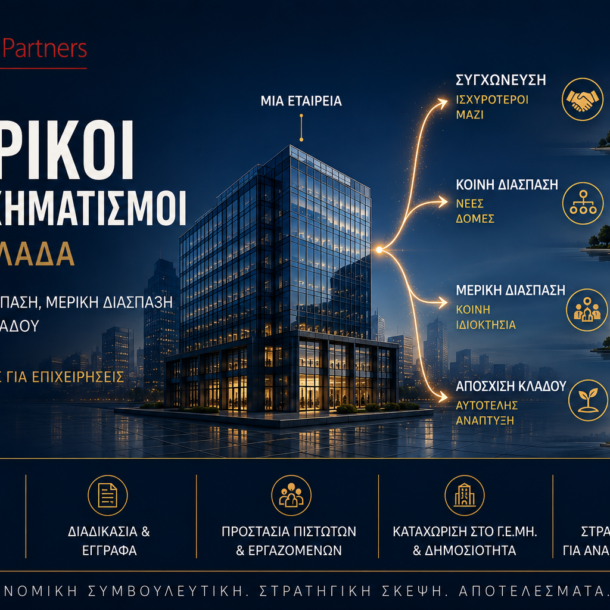
Η απόσχιση κλάδου του ν. 4601/2019 επιτρέπει σε μία εταιρεία, χωρίς να λυθεί, να μεταφέρει έναν ή περισσότερους αυτοτελείς κλάδους δραστηριότητας σε υφιστάμενη ή νέα επωφελούμενη εταιρεία. Σε αντάλλαγμα, οι εταιρικές συμμετοχές της επωφελούμενης δεν δίνονται στους μετόχους της αρχικής εταιρείας αλλά στην ίδια τη διασπώμενη εταιρεία, η οποία καθίσταται μέτοχος ή εταίρος της επωφελούμενης. Η καθολική διαδοχή καταλαμβάνει τον κλάδο που περιγράφεται στη σύμβαση διάσπασης, γεγονός που καθιστά την απόσχιση ιδιαίτερα σημαντικό εργαλείο για corporate carve-outs, δημιουργία θυγατρικών, είσοδο επενδυτών και προετοιμασία μελλοντικής πώλησης επιχειρηματικής δραστηριότητας.
Μία εταιρεία μπορεί να έχει αναπτύξει μέσα στην ίδια νομική οντότητα περισσότερες από μία δραστηριότητες.
Για παράδειγμα, μία Ανώνυμη Εταιρεία μπορεί να διαθέτει:
Κάποια στιγμή μπορεί να προκύψει η ανάγκη μία από αυτές τις δραστηριότητες να αποκτήσει δική της εταιρική υπόσταση.
Η απλούστερη σκέψη θα ήταν: «Μεταφέρουμε τα assets σε μία νέα εταιρεία.» Η απόσχιση κλάδου, όμως, λειτουργεί διαφορετικά. Δεν αντιμετωπίζει την επιχειρηματική δραστηριότητα ως μία απλή συλλογή στοιχείων ενεργητικού. Αντιμετωπίζει έναν οργανωμένο και αυτοτελή επιχειρηματικό κλάδο ως ενιαία λειτουργική οικονομική μονάδα. Και αυτό ακριβώς είναι το σημείο που της δίνει ιδιαίτερη αξία στο σύγχρονο corporate restructuring.
Το άρθρο 57 του ν. 4601/2019 προβλέπει ότι η απόσχιση κλάδου μπορεί να πραγματοποιηθεί:
Στην περίπτωση της απόσχισης με απορρόφηση, η διασπώμενη εταιρεία:
Αντίστοιχα, στην απόσχιση με σύσταση νέας εταιρείας, ο κλάδος μεταφέρεται σε εταιρεία που δημιουργείται ταυτόχρονα και οι συμμετοχές της νέας εταιρείας αποδίδονται πάλι στην ίδια τη διασπώμενη.
Αν μία εταιρεία Α διαθέτει έναν αυτοτελή κλάδο Β και αποφασίσει να τον αποσχίσει σε μία νέα εταιρεία Γ, το αποτέλεσμα μπορεί να είναι:
ΠΡΙΝ
Company A
├── Core Business
└── Business B
ΜΕΤΑ
Company A
├── Core Business
└── 100% ή άλλο συμφωνημένο ποσοστό συμμετοχής στη Company C
Company C
└── Business B
Η αρχική εταιρεία δεν εξαφανίζεται. Ο κλάδος αλλάζει εταιρικό «σπίτι». Η αρχική εταιρεία λαμβάνει τις συμμετοχές της εταιρείας στην οποία ο κλάδος μεταφέρθηκε. Αυτό είναι το βασικό structural logic της απόσχισης.
Εδώ βρίσκεται μία από τις σημαντικότερες νομικές προϋποθέσεις. Ο νόμος δεν επιτρέπει να χαρακτηριστεί αυθαίρετα ως κλάδος οποιοδήποτε asset ή ομάδα assets.
Κατά το άρθρο 54, κλάδος δραστηριότητας είναι το σύνολο των στοιχείων ενεργητικού και παθητικού που, από οργανωτική άποψη, αποτελούν αυτόνομη εκμετάλλευση, δηλαδή σύνολο ικανό να λειτουργήσει αυτοδύναμα.
Άρα το κρίσιμο test είναι λειτουργικό: Μπορεί αυτό που μεταφέρεται να σταθεί ως αυτοτελής επιχειρηματική δραστηριότητα;
Δεν αρκεί απλώς να υπάρχει:
Πρέπει να εξεταστεί εάν τα στοιχεία που συνδέονται με τη δραστηριότητα σχηματίζουν ένα οργανωμένο σύνολο με πραγματική λειτουργική αυτονομία.
Η απάντηση δεν δίνεται με έναν εξαντλητικό κατάλογο. Η κρίσιμη διάταξη είναι το άρθρο 59, το οποίο απαιτεί στο σχέδιο σύμβασης διάσπασης ακριβή καταγραφή και κατανομή των περιουσιακών στοιχείων και των υποχρεώσεων που μεταβιβάζονται σε κάθε επωφελούμενη εταιρεία. Στην πράξη, ένας πραγματικός business branch μπορεί να περιλαμβάνει, ανάλογα με τη συγκεκριμένη επιχείρηση:
Assets
Contracts
Liabilities
Operational components
Η ακριβής περίμετρος πρέπει όμως να προσδιορίζεται με ιδιαίτερη προσοχή στο σχέδιο και στη σύμβαση διάσπασης.
Η απόσχιση κλάδου δεν πρέπει να ξεκινά από τη σύνταξη της σύμβασης. Πρέπει να ξεκινά από ένα branch perimeter exercise. Η εταιρεία πρέπει πρώτα να απαντήσει: Τι ακριβώς ανήκει στον κλάδο;
Αυτό σημαίνει να δημιουργηθεί ένας σαφής χάρτης:
Assets → Contracts → Liabilities → Employees → IP → Data → Litigation → Licences
Το άρθρο 59 δεν αντιμετωπίζει αυτή την καταγραφή ως δευτερεύουσα λεπτομέρεια. Την εντάσσει ρητά στο υποχρεωτικό περιεχόμενο του σχεδίου διάσπασης.
Ακόμη πιο σημαντικό: ο νόμος προβλέπει ειδικούς κανόνες για την περίπτωση κατά την οποία ορισμένα στοιχεία ενεργητικού ή παθητικού δεν έχουν κατανεμηθεί επαρκώς και η σύμβαση δεν επιτρέπει να εξακριβωθεί πού ανήκουν.
Άρα μία ασαφής περιγραφή δεν αποτελεί απλώς drafting weakness. Μπορεί να δημιουργήσει πραγματικό post-closing πρόβλημα.
Αυτό είναι ίσως το ισχυρότερο νομικό χαρακτηριστικό της απόσχισης. Το άρθρο 70 προβλέπει ότι από την καταχώριση της διάσπασης στο Γ.Ε.ΜΗ.:
Στην περίπτωση ειδικά της απόσχισης κλάδου, η καθολική διαδοχή καταλαμβάνει τον κλάδο δραστηριότητας που καθορίζεται στη σύμβαση διάσπασης. Αυτό σημαίνει ότι ο νόμος αντιμετωπίζει τη μεταφορά ως ενιαία διαδοχή του κλάδου και όχι ως απλή σειρά μεμονωμένων εκχωρήσεων.
Όχι. Αυτό θα ήταν επικίνδυνο συμπέρασμα. Η καθολική διαδοχή είναι εξαιρετικά ισχυρός μηχανισμός, αλλά δεν καταργεί την ανάγκη due diligence.
Ο ίδιος ο νόμος διευκρινίζει ότι οι ιδιαίτερες διατυπώσεις που προβλέπονται από ειδικές διατάξεις για τη μεταβίβαση συγκεκριμένων περιουσιακών στοιχείων εξακολουθούν να ισχύουν.
Στην πράξη πρέπει να ελεγχθούν, μεταξύ άλλων:
Η σωστή θέση λοιπόν δεν είναι: «Καθολική διαδοχή = δεν χρειάζεται due diligence.» Είναι:
«Καθολική διαδοχή = ισχυρός μηχανισμός μεταφοράς, ο οποίος πρέπει να σχεδιαστεί πάνω σε πλήρη due diligence.»
Το άρθρο 70 προβλέπει ότι οι εκκρεμείς δίκες συνεχίζονται αυτοδίκαια και χωρίς άλλη διατύπωση από τις επωφελούμενες εταιρείες, σύμφωνα με την κατανομή που προβλέπεται στο σχέδιο σύμβασης διάσπασης.
Αυτό έχει ιδιαίτερη πρακτική σημασία. Αν ο κλάδος που μεταφέρεται έχει:
δεν αρκεί να εξεταστεί το operational business.
Πρέπει να χαρτογραφηθεί και το litigation footprint του κλάδου.
Εδώ βρίσκεται η χαρακτηριστική διαφορά από τη μερική διάσπαση.
Στην απόσχιση κλάδου, η ίδια η διασπώμενη εταιρεία γίνεται μέτοχος ή εταίρος της επωφελούμενης εταιρείας και λαμβάνει τις συμμετοχές που προβλέπει η σύμβαση διάσπασης.
Αυτό δημιουργεί μία εταιρική σχέση:
Parent → Subsidiary
αντί για:
Shareholders → Parallel Companies
Και αυτή ακριβώς η διαφορά εξηγεί γιατί η απόσχιση κλάδου είναι τόσο ενδιαφέρουσα σε δομές carve-out.
Ναι, υπό την προϋπόθεση ότι υπάρχει πραγματικός αυτοτελής κλάδος και ότι ο συγκεκριμένος μετασχηματισμός εξυπηρετεί τη συνολική εταιρική και φορολογική στρατηγική.
Ένα carve-out συνήθως επιδιώκει να διαχωρίσει:
ενός business unit από το υπόλοιπο group. Η απόσχιση κλάδου μπορεί να παρέχει την εταιρική «γέφυρα» για αυτόν τον διαχωρισμό.
Ας δούμε ένα πρακτικό παράδειγμα. Μία ελληνική Α.Ε. έχει:
Business A: Consulting
Business B: AI Technology Platform
Η αξία και το investment thesis των δύο δραστηριοτήτων είναι τελείως διαφορετικά. Ένας επενδυτής ενδιαφέρεται μόνο για το AI platform. Αν επενδύσει απευθείας στην υφιστάμενη εταιρεία, αποκτά οικονομικό συμφέρον και στα δύο businesses. Μία πιθανή δομή είναι:
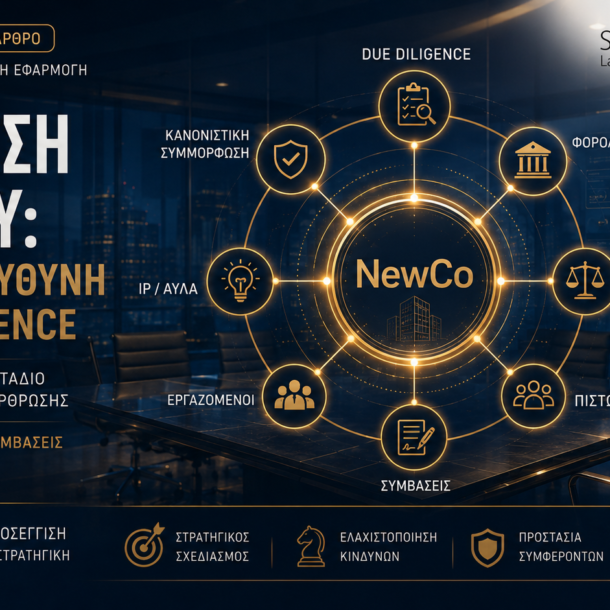
Αναγνωρίζεται αν το Technology Business αποτελεί αυτοτελή κλάδο.
Ο κλάδος μεταφέρεται με απόσχιση σε NewCo.
Η αρχική εταιρεία λαμβάνει τις συμμετοχές της NewCo.
Ο επενδυτής εισέρχεται στη NewCo μέσω:
Έτσι:
Parent Company
↓
NewCo / Product Company
↓
Investor
Η απόσχιση λειτουργεί ως pre-transaction restructuring.
Ανάλογη χρήση μπορεί να υπάρξει πριν από την πώληση ενός business unit.
Ένας αγοραστής ενδέχεται να μην θέλει να αποκτήσει:
Θέλει μόνο συγκεκριμένο business.
Η απόσχιση μπορεί να χρησιμοποιηθεί για να οργανωθεί το business μέσα σε χωριστή εταιρική οντότητα πριν από την πώληση.
Η επόμενη συναλλαγή μπορεί κατόπιν να είναι share deal επί της νέας εταιρείας.
Αλλά εδώ απαιτείται μεγάλη προσοχή:
η απόσχιση δεν λειτουργεί ως μηχανισμός «μαγικού καθαρισμού» liabilities.
Η περίμετρος του κλάδου και οι υποχρεώσεις που τον συνοδεύουν πρέπει να χαρτογραφηθούν με ακρίβεια.
Σε technology businesses, το IP συχνά αποτελεί τον πυρήνα της αξίας του κλάδου.
Πριν από τον μετασχηματισμό πρέπει να εξεταστούν:
Ένα business δεν είναι πραγματικά «carved out» αν το core IP παραμένει νομικά αλλού ή αν η chain of title είναι ελλιπής.
Γι’ αυτό η απόσχιση δεν πρέπει να αντιμετωπίζεται μόνο ως corporate exercise.
Συχνά είναι και IP restructuring exercise.
Το άρθρο 64 του ν. 4601/2019 προβλέπει ότι η προστασία των δικαιωμάτων των εργαζομένων στις εταιρείες που συμμετέχουν στη διάσπαση ρυθμίζεται από τις οικείες διατάξεις.
Άρα η εταιρεία πρέπει να εξετάσει χωριστά:
Το ανθρώπινο δυναμικό δεν μπορεί να αντιμετωπιστεί ως απλό «asset schedule».
Η προστασία των πιστωτών αποτελεί αυτοτελές επίπεδο της διαδικασίας.
Το άρθρο 65 προβλέπει, υπό τις προϋποθέσεις του, δυνατότητα πιστωτών με προγενέστερες μη ληξιπρόθεσμες απαιτήσεις να ζητήσουν κατάλληλες εγγυήσεις, όταν αποδεικνύουν ότι η οικονομική κατάσταση που δημιουργείται από τη διάσπαση καθιστά αναγκαία τέτοια προστασία.
Ακόμη σημαντικότερο, ο νόμος προβλέπει υπό προϋποθέσεις εις ολόκληρον ευθύνη, συμπεριλαμβάνοντας στην περίπτωση της απόσχισης και την ίδια τη διασπώμενη εταιρεία, ενώ οι σχετικές απαιτήσεις υπόκεινται στην ειδική πενταετή παραγραφή που προβλέπει το άρθρο.
Άρα η απόσχιση δεν αποτελεί εργαλείο αυθαίρετης αποκοπής πιστωτών.
Για να δούμε καθαρά τη νομική λογική:
Η διασπώμενη δεν λύεται.
Πρέπει να υπάρχει οργανωμένο σύνολο ενεργητικού και παθητικού ικανό να λειτουργήσει αυτοδύναμα.
Μπορεί να είναι:
Το σχέδιο πρέπει να καταγράφει με ακρίβεια τα μεταφερόμενα assets και liabilities.
Οι συμμετοχές της επωφελούμενης αποδίδονται στην ίδια τη διασπώμενη εταιρεία.
Ακολουθούν σχέδιο, εκθέσεις και λοιπές απαιτούμενες εταιρικές και δημοσιευτικές πράξεις.
Με την καταχώριση συντελείται ο μετασχηματισμός.
Η επωφελούμενη καθίσταται καθολική διάδοχος στον κλάδο που έχει καθοριστεί στη σύμβαση.
Το σχέδιο διάσπασης είναι στην πραγματικότητα το «blueprint» της συναλλαγής.
Πρέπει να αποτυπώνει, μεταξύ άλλων:
Άρα η ποιότητα της απόσχισης εξαρτάται σε μεγάλο βαθμό από την ποιότητα του perimeter drafting.
Το διοικητικό συμβούλιο ή οι διαχειριστές συντάσσουν λεπτομερή έκθεση που αιτιολογεί νομικά και οικονομικά το σχέδιο διάσπασης. Ειδικά στην απόσχιση κλάδου, η έκθεση πρέπει να επεξηγεί τον αριθμό των συμμετοχών της επωφελούμενης που αποδίδονται στη διασπώμενη εταιρεία και να αναφέρει, μεταξύ άλλων, τυχόν ιδιαίτερες δυσχέρειες αποτίμησης.
Αυτό δείχνει κάτι σημαντικό:
Η απόσχιση δεν είναι απλώς transfer documentation.
Πρέπει να υπάρχει και τεκμηριωμένη οικονομική λογική του μετασχηματισμού.
Για κατάλληλη περίπτωση, ο μηχανισμός μπορεί να προσφέρει:
1. Νομικό separation του business
Ο κλάδος αποκτά δική του εταιρική οντότητα.
2. Διατήρηση ownership από τη μητρική
Η αρχική εταιρεία λαμβάνει τις συμμετοχές.
3. Ευκολότερο investor entry
Ο επενδυτής μπορεί να επενδύσει στο συγκεκριμένο vehicle.
4. Προετοιμασία share sale
Ο απομονωμένος κλάδος μπορεί να αποτελεί αντικείμενο μεταγενέστερης συναλλαγής.
5. Operational clarity
Ξεχωριστά assets, liabilities, governance και οικονομικές καταστάσεις.
6. Strategic flexibility
Δυνατότητα διαφορετικής χρηματοδότησης, management και growth strategy.
Η ίδια δομή μπορεί να αποτύχει αν ο σχεδιασμός είναι ανεπαρκής.
Οι σημαντικότεροι κίνδυνοι είναι:
Λανθασμένος προσδιορισμός του κλάδου
Αν το business δεν αποτελεί αυτοτελή λειτουργική μονάδα, η βασική νομική προϋπόθεση πρέπει να επανεξεταστεί.
Incomplete perimeter
Κρίσιμα assets ή liabilities μπορεί να μείνουν εκτός.
IP mismatch
Το προϊόν μεταφέρεται αλλά τα βασικά IP rights παραμένουν στη μητρική.
Contractual mismatch
Οι εμπορικές σχέσεις δεν ακολουθούν λειτουργικά τη νέα δομή.
Employee mismatch
Το ανθρώπινο δυναμικό δεν χαρτογραφείται μαζί με τη δραστηριότητα.
Legacy liabilities
Εσφαλμένη πεποίθηση ότι η απόσχιση εξαλείφει ιστορικούς κινδύνους.
Tax structure risk
Ο εταιρικός μηχανισμός επιλέγεται χωρίς ταυτόχρονο φορολογικό σχεδιασμό.
Ένας ουσιαστικός pre-spin-off legal review πρέπει τουλάχιστον να εξετάσει:
Μία ελληνική εταιρεία διαθέτει:
Το AI Product έχει:
Η εταιρεία θέλει να αναζητήσει στρατηγικό επενδυτή αποκλειστικά για το AI Product.
Μία πιθανή προσέγγιση είναι:
Step 1: Νομικός και οικονομικός έλεγχος εάν το Product Division αποτελεί αυτοτελή κλάδο.
Step 2: Καθορισμός branch perimeter.
Step 3: Δημιουργία NewCo.
Step 4: Απόσχιση του κλάδου στη NewCo.
Step 5: Η Parent αποκτά τις συμμετοχές της NewCo.
Step 6: Ο επενδυτής επενδύει στη NewCo.
Το αποτέλεσμα μπορεί να είναι:
Parent Company – 80%
Investor – 20%
↓
Product NewCo χωρίς ο επενδυτής να αποκτήσει συμμετοχή στο υπόλοιπο business της Parent.
Αυτό είναι ακριβώς το σημείο όπου το corporate law συναντά το investment structuring.
Δεν είναι το ίδιο.
| Ζήτημα | Απόσχιση κλάδου | Asset Transfer |
|---|---|---|
| Νομική βάση | Εταιρικός μετασχηματισμός | Συμβατική μεταβίβαση |
| Τι μεταφέρεται | Αυτοτελής κλάδος | Επιλεγμένα assets |
| Καθολική διαδοχή | Ναι, στον καθορισμένο κλάδο | Κατά κανόνα όχι |
| Αντάλλαγμα | Συμμετοχές στην επωφελούμενη προς τη διασπώμενη | Συνήθως τίμημα |
| Ownership result | Parent → Beneficiary | Εξαρτάται από τη συναλλαγή |
| Κατάλληλο για carve-out | Συχνά ναι | Επίσης δυνατό, αλλά διαφορετική δομή |
| Due diligence | Απαραίτητο | Απαραίτητο |
Η επιλογή εξαρτάται από τον τελικό σκοπό.
Η απάντηση εξαρτάται κυρίως από το πού θέλουμε να καταλήξουν οι συμμετοχές της επωφελούμενης εταιρείας.
Αν θέλουμε τους υφιστάμενους μετόχους να κατέχουν άμεσα τη νέα εταιρεία, εξετάζουμε τη μερική διάσπαση.
Αν θέλουμε η αρχική εταιρεία να κατέχει τη νέα εταιρεία, εξετάζουμε την απόσχιση κλάδου.
Αυτή η επιλογή έχει τόσο μεγάλη σημασία για ownership, cap table, governance και investor entry, ώστε θα αποτελέσει ολόκληρο το Άρθρο 3 της σειράς.
Η απόσχιση κλάδου είναι πολύ περισσότερο από μία τεχνική μεταφορά assets.
Είναι ένας μηχανισμός εταιρικής αναδιάρθρωσης που επιτρέπει σε μία επιχείρηση να απομονώσει έναν πραγματικά αυτοτελή business unit, να τον μεταφέρει σε άλλη εταιρική οντότητα και να διατηρήσει την ιδιοκτησία της μέσω των συμμετοχών που λαμβάνει στην επωφελούμενη εταιρεία.
Η καθολική διαδοχή στον καθορισμένο κλάδο, η δυνατότητα δημιουργίας parent–subsidiary structure και η δυνατότητα να ακολουθήσει επενδυτική ή M&A συναλλαγή καθιστούν τον μηχανισμό ιδιαίτερα σημαντικό για επιχειρήσεις που εξετάζουν:
carve-out → spin-off → investor entry → strategic partnership → future sale.
Η επιτυχία όμως της απόσχισης εξαρτάται από ένα σημείο περισσότερο από οποιοδήποτε άλλο:
την ακριβή οριοθέτηση του κλάδου.
Assets, liabilities, contracts, employees, IP, litigation και regulatory matters πρέπει να αποτυπωθούν ως ένα συνεκτικό business perimeter.
Εκεί κρίνεται αν το carve-out θα δημιουργήσει μία πραγματικά λειτουργική και επενδύσιμη νέα εταιρεία ή απλώς μία νομική οντότητα με επιχειρηματικά κενά.
Είναι εταιρικός μετασχηματισμός κατά τον οποίο μία εταιρεία, χωρίς να λυθεί, μεταφέρει έναν ή περισσότερους αυτοτελείς κλάδους σε υφιστάμενη ή νέα επωφελούμενη εταιρεία και λαμβάνει η ίδια τις συμμετοχές της επωφελούμενης.
Όχι. Συνεχίζει κανονικά να υφίσταται.
Σύνολο ενεργητικού και παθητικού που αποτελεί οργανωτικά αυτοδύναμη επιχειρηματική εκμετάλλευση.
Στην απόσχιση κλάδου τις λαμβάνει η ίδια η διασπώμενη εταιρεία.
Ναι. Η καθολική διαδοχή αφορά τον κλάδο δραστηριότητας που καθορίζεται στη σύμβαση διάσπασης.
Ναι. Ο νόμος επιτρέπει απόσχιση με σύσταση μίας ή περισσότερων νέων εταιρειών.
Ναι, μπορεί να αποτελέσει κατάλληλο pre-investment restructuring όταν ένας επενδυτής ενδιαφέρεται για συγκεκριμένο business unit. Η τελική καταλληλότητα απαιτεί εξατομικευμένο εταιρικό και φορολογικό έλεγχο.
Συνεχίζονται αυτοδίκαια από τις επωφελούμενες εταιρείες σύμφωνα με την κατανομή της σύμβασης διάσπασης.
Ναι. Ο ν. 4601/2019 προβλέπει ειδικούς μηχανισμούς προστασίας και, υπό προϋποθέσεις, παροχή εγγυήσεων και εις ολόκληρον ευθύνη.
Τα δικαιώματά τους προστατεύονται σύμφωνα με τις ειδικές εφαρμοστέες διατάξεις.
Όχι. Η βασική διαφορά είναι ότι στην απόσχιση οι συμμετοχές της επωφελούμενης περιέρχονται στην ίδια τη διασπώμενη εταιρεία, ενώ στη μερική διάσπαση περιέρχονται στους μετόχους ή εταίρους της.
Κάθε υπόθεση έχει ιδιαιτερότητες που χρήζουν προσοχής. Κλείστε online ραντεβού και λάβετε καθοδήγηση προσαρμοσμένη στη δική σας περίπτωση.
A business branch spin-off under Greek Law 4601/2019 allows a company, without being dissolved, to transfer one or more autonomous business branches to an existing or newly incorporated beneficiary company. In return, the shares or other equity interests in the beneficiary company are allocated not to the shareholders of the original company, but to the demerged company itself, which becomes a shareholder or partner in the beneficiary company. Universal succession applies to the business branch identified in the demerger agreement, making the spin-off a particularly important tool for corporate carve-outs, subsidiary creation, investor entry and preparation for a future sale of a specific business activity.
A company may develop more than one business activity within the same legal entity.
For example, a Greek Société Anonyme may operate:
At some point, one of those activities may need to acquire its own corporate identity.
The simplest thought might be:
“We transfer the assets to a new company.”
A business branch spin-off, however, operates differently.
It does not treat the business activity as a simple collection of assets.
It treats an organised and autonomous business branch as a single functional economic unit.
That is precisely what gives the mechanism particular value in modern corporate restructuring.
Article 57 of Greek Law 4601/2019 provides that a business branch spin-off may be carried out:
In the case of a spin-off by absorption, the demerged company:
Similarly, in a spin-off through incorporation of a new company, the business branch is transferred to a company incorporated simultaneously, and the equity interests in that new company are again allocated to the demerged company itself.
If Company A operates an autonomous Business B and decides to spin it off into a new Company C, the result may look like this:
BEFORE
Company A
├── Core Business
└── Business B
AFTER
Company A
├── Core Business
└── 100% or another agreed equity interest in Company C
Company C
└── Business B
The original company does not disappear.
The business branch changes its corporate “home”.
The original company receives the shares or other equity interests in the company to which the business branch has been transferred.
This is the core structural logic of a business branch spin-off.
This is one of the most important legal requirements.
The law does not allow any individual asset or arbitrary group of assets to be labelled a “business branch”.
Under Article 54, a business branch consists of the totality of assets and liabilities which, from an organisational perspective, constitute an autonomous business operation capable of functioning by its own means.
The critical test is therefore functional:
Can what is being transferred operate as an autonomous business activity?
It is not enough merely to have:
The relevant assets and liabilities must be examined together to determine whether they form an organised business unit with genuine functional autonomy.
The law does not provide an exhaustive checklist.
The key provision is Article 59, which requires the draft demerger agreement to include an accurate description and allocation of the assets and liabilities transferred to each beneficiary company.
In practice, depending on the business, an autonomous branch may include:
Assets
Contracts
Liabilities
Operational components
The precise perimeter must, however, be carefully defined in the draft and final demerger agreement.
A business branch spin-off should not begin with drafting the agreement.
It should begin with a branch perimeter exercise.
The company must first answer:
What exactly belongs to the branch?
This requires a clear map of:
Assets → Contracts → Liabilities → Employees → IP → Data → Litigation → Licences
Article 59 does not treat this mapping as a secondary detail. It expressly includes the accurate description and allocation of assets and liabilities among the mandatory elements of the draft demerger agreement.
Even more importantly, the law provides specific rules where certain assets or liabilities have not been adequately allocated and the agreement does not make it possible to determine where they belong.
An unclear branch description is therefore not merely a drafting weakness.
It may create a real post-closing problem.
This is perhaps the strongest legal feature of the mechanism.
Article 70 provides that, upon registration of the demerger with the General Commercial Registry, or G.E.MI.:
In the specific case of a business branch spin-off, universal succession applies to the business branch identified in the demerger agreement.
This means that the law treats the transaction as a unified transfer of the branch rather than as a mere sequence of individual assignments.
No. That would be a dangerous conclusion.
Universal succession is a powerful transfer mechanism, but it does not eliminate the need for due diligence.
The law itself makes clear that any special formalities required by specific provisions for the transfer of particular assets continue to apply in the context of a demerger.
In practice, the review should include, among other matters:
The correct approach is therefore not:
“Universal succession = no due diligence required.”
It is:
“Universal succession = a powerful transfer mechanism that must be structured on the basis of full due diligence.”
Article 70 provides that pending proceedings continue automatically, without any additional formality, in the name of the beneficiary companies according to the allocation provided for in the draft demerger agreement.
This has considerable practical importance.
If the transferred branch is connected with:
the analysis cannot be limited to the operational business.
The litigation footprint of the branch must also be mapped.
This is the defining distinction between a business branch spin-off and a partial demerger.
In a business branch spin-off, the demerged company itself becomes a shareholder or partner in the beneficiary company and receives the equity interests specified in the demerger agreement.
This creates a corporate relationship of:
Parent → Subsidiary
rather than:
Shareholders → Parallel Companies
This is exactly why the mechanism is so interesting in carve-out structures.
Yes, provided that a genuine autonomous business branch exists and the particular transformation fits the broader corporate and tax strategy.
A carve-out normally seeks to separate:
of one business unit from the remainder of the group.
A business branch spin-off may provide the corporate bridge through which that separation is implemented.
Consider a practical example.
A Greek A.E. operates:
Business A: Consulting
Business B: AI Technology Platform
The value and investment thesis of the two businesses are entirely different.
An investor is interested only in the AI platform.
If the investor subscribes directly into the existing company, it may gain economic exposure to both businesses.
One possible structure is:
Determine whether the Technology Business constitutes an autonomous business branch.
Define the branch perimeter.
Incorporate a NewCo.
Spin off the business branch into the NewCo.
The parent company receives the shares in the NewCo.
The investor enters the NewCo through:
The resulting structure may be:
Parent Company
↓
NewCo / Product Company
↓
Investor
The spin-off therefore operates as pre-transaction restructuring.
A similar use may arise before the sale of a business unit.
A purchaser may not wish to acquire:
The purchaser may be interested only in one specific business.
A spin-off can be used to organise that business within a separate corporate entity before the sale.
The subsequent transaction may then be structured as a share deal involving the new company.
However, caution is essential.
A spin-off is not a mechanism that magically “cleans” liabilities.
The perimeter of the branch and the obligations attached to it must be mapped accurately.
In technology businesses, intellectual property is often at the core of the value of the branch.
Before the transformation, the company should examine:
A business is not genuinely “carved out” if its core IP remains legally elsewhere or if its chain of title is incomplete.
For this reason, a business branch spin-off should not be treated solely as a corporate exercise.
It is often also an IP restructuring exercise.
Article 64 of Law 4601/2019 provides that the protection of employee rights in the companies participating in the demerger is governed by the applicable provisions.
The company must therefore separately examine:
Employees cannot be treated as a simple item in an “asset schedule”.
Creditor protection constitutes a separate layer of the transaction.
Article 65 provides, subject to its conditions, that creditors holding pre-existing claims that have not yet become due may request appropriate safeguards where they sufficiently demonstrate that the financial position resulting from the demerger makes such protection necessary.
Even more importantly, the law provides, subject to specific conditions, for joint and several liability, including in the case of a business branch spin-off the demerged company itself, while the relevant claims are subject to the specific five-year limitation period provided by the statute.
Accordingly, a business branch spin-off is not a tool for arbitrarily cutting creditors off from recourse.
The legal logic can be presented clearly as follows:
The demerged company is not dissolved.
There must be an organised set of assets and liabilities capable of operating independently.
It may be:
The draft agreement must accurately identify the assets and liabilities to be transferred.
The equity interests in the beneficiary company are allocated to the demerged company itself.
The required draft agreement, reports and other corporate and publication formalities are completed.
The transformation is completed upon registration.
The beneficiary company becomes universal successor in respect of the business branch identified in the agreement.
The draft demerger agreement is effectively the blueprint of the transaction.
It must set out, among other matters:
The quality of the spin-off therefore depends to a considerable extent on the quality of the branch-perimeter drafting.
The board of directors or managers prepares a detailed report explaining and justifying the draft demerger agreement from a legal and economic perspective.
Specifically in a business branch spin-off, the report must explain the number of equity interests in the beneficiary company to be allocated to the demerged company and must also identify, among other matters, any particular valuation difficulties.
This demonstrates an important point:
A spin-off is not merely transfer documentation.
There must also be a documented economic rationale for the transformation.
In an appropriate case, the mechanism may offer:
1. Legal separation of the business
The business branch acquires its own corporate vehicle.
2. Ownership retained by the parent
The original company receives the equity interests in the beneficiary company.
3. Easier investor entry
An investor can invest in the specific vehicle.
4. Preparation for a share sale
The separated branch may become the subject of a later transaction.
5. Operational clarity
Separate assets, liabilities, governance and financial statements.
6. Strategic flexibility
The business may adopt a different financing, management and growth strategy.
The same structure can fail if the planning is inadequate.
The most important risks include:
Incorrect identification of the business branch
If the business does not constitute an autonomous functional unit, the basic legal premise must be reconsidered.
Incomplete perimeter
Critical assets or liabilities may remain outside the spin-off.
IP mismatch
The product is transferred, but the core IP remains with the parent.
Contractual mismatch
Commercial relationships do not follow the new operating structure.
Employee mismatch
Personnel are not mapped consistently with the business activity.
Legacy liabilities
There is an incorrect assumption that the spin-off eliminates historic risks.
Tax-structure risk
The corporate mechanism is selected without parallel tax planning.
A substantive pre-spin-off legal review should examine at least:
A Greek company operates:
The AI Product has:
The company wants to attract a strategic investor exclusively for the AI Product.
One possible approach is:
Step 1: Legal and economic assessment of whether the Product Division constitutes an autonomous business branch.
Step 2: Definition of the branch perimeter.
Step 3: Incorporation of a NewCo.
Step 4: Spin-off of the business branch into the NewCo.
Step 5: The Parent receives the shares in the NewCo.
Step 6: The investor invests in the NewCo.
The resulting structure may be:
Parent Company – 80%
Investor – 20%
↓
Product NewCo
without the investor acquiring an equity interest in the remainder of the Parent’s business.
This is precisely where corporate law meets investment structuring.
They are not the same.
| Issue | Business Branch Spin-Off | Asset Transfer |
|---|---|---|
| Legal basis | Corporate transformation | Contractual transfer |
| What is transferred | Autonomous business branch | Selected assets |
| Universal succession | Yes, for the identified branch | Generally no |
| Consideration | Equity interests in the beneficiary company allocated to the demerged company | Usually a purchase price |
| Ownership result | Parent → Beneficiary | Depends on the transaction |
| Suitable for carve-out | Often yes | Also possible, but with a different structure |
| Due diligence | Essential | Essential |
The appropriate choice depends on the ultimate objective.
The answer depends primarily on where the equity interests in the beneficiary company are intended to end up.
If the objective is:
for the existing shareholders to hold the new company directly, a partial demerger may be considered.
If the objective is:
for the original company to own the new company, a business branch spin-off may be considered.
This distinction has such significant implications for ownership, cap table, governance and investor entry that it will form the subject of Article 3 of this series.
A business branch spin-off is much more than a technical transfer of assets.
It is a corporate restructuring mechanism that allows a business to isolate a genuinely autonomous business unit, transfer it to another corporate vehicle and retain ownership through the equity interests it receives in the beneficiary company.
Universal succession in respect of the identified branch, the ability to create a parent-subsidiary structure and the possibility of a subsequent investment or M&A transaction make the mechanism particularly relevant for businesses considering:
carve-out → spin-off → investor entry → strategic partnership → future sale.
The success of the transaction, however, depends more than anything else on one issue:
the accurate definition of the business branch perimeter.
Assets, liabilities, contracts, employees, intellectual property, litigation and regulatory matters must be mapped as one coherent business perimeter.
That is where it is ultimately determined whether the carve-out will produce a genuinely functional and investable new company or merely a legal entity with operational gaps.
It is a corporate transformation under which a company, without being dissolved, transfers one or more autonomous business branches to an existing or newly incorporated beneficiary company and itself receives the equity interests in that beneficiary company.
No. The original company continues to exist.
It is a set of assets and liabilities which, from an organisational perspective, forms an autonomous business operation capable of functioning by its own means.
In a business branch spin-off, the demerged company itself receives the shares or other equity interests.
Yes. Universal succession applies to the business branch identified in the demerger agreement.
Yes. The law allows a business branch spin-off through the incorporation of one or more new companies.
Yes. It may constitute an appropriate pre-investment restructuring tool where an investor is interested in a specific business unit. Its suitability must, however, be assessed through a case-specific corporate and tax review.
Pending proceedings continue automatically in the name of the beneficiary companies according to the allocation in the demerger agreement.
Yes. Law 4601/2019 provides specific creditor-protection mechanisms and, subject to conditions, appropriate safeguards and joint and several liability.
Their rights are protected in accordance with the applicable legal provisions.
No. The key distinction is that in a business branch spin-off, the equity interests in the beneficiary company are allocated to the demerged company itself, while in a partial demerger they are allocated to the shareholders or partners of the demerged company.
Every case has its own particular circumstances that require careful consideration. Book an online appointment and receive legal guidance tailored to your specific situation.