2 Σεπτεμβρίου, 2026
Άρθρα και γνώμες
· Άρθρα με άποψη
· Τελευταία νέα

Η απόσχιση κλάδου μπορεί να δημιουργήσει μία καθαρή, αυτοτελή και επενδύσιμη NewCo, αλλά δεν εξαφανίζει αυτομάτως φορολογικούς, συμβατικούς ή ιστορικούς κινδύνους. Ο ν. 4601/2019 προβλέπει προστασία πιστωτών, καθολική διαδοχή στον μεταφερόμενο κλάδο και, υπό προϋποθέσεις, εις ολόκληρον ευθύνη, ενώ το νέο φορολογικό πλαίσιο του ν. 5162/2024 προβλέπει φορολογική ουδετερότητα και σημαντικές απαλλαγές υπό συγκεκριμένους όρους. Το πραγματικό risk management βρίσκεται στην ακριβή οριοθέτηση του κλάδου, στις υποχρεώσεις που τον ακολουθούν, στα contracts, στο IP, στους εργαζομένους, στη φορολογία και στην προετοιμασία της NewCo για επόμενο investor ή buyer due diligence.
Στα προηγούμενα τέσσερα άρθρα της σειράς είδαμε:
Part 1: τι είναι οι εταιρικοί μετασχηματισμοί,
Part 2: πώς λειτουργεί η απόσχιση κλάδου,
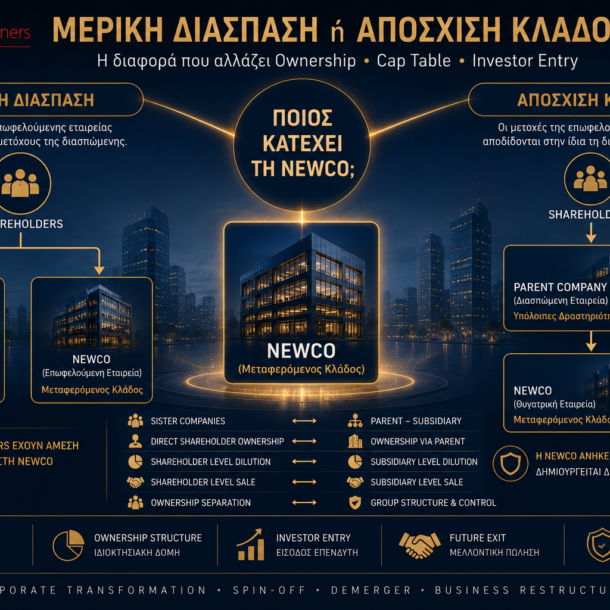
Part 3: γιατί η μερική διάσπαση και η απόσχιση οδηγούν σε διαφορετικό ownership structure,
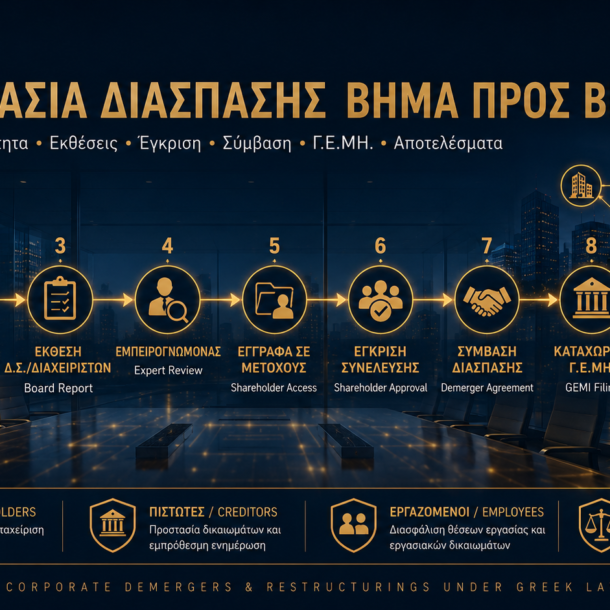
Part 4: πώς εκτελείται η απόσχιση βήμα προς βήμα.
Το τελευταίο και ίσως σημαντικότερο ερώτημα είναι τώρα:
Τι μπορεί να πάει στραβά ακόμη και όταν ο εταιρικός μετασχηματισμός έχει ολοκληρωθεί κανονικά;
Η απάντηση είναι: αρκετά.
Μία εταιρεία μπορεί να έχει δημιουργήσει μία απολύτως νόμιμη NewCo και παρ’ όλα αυτά να ανακαλύψει λίγους μήνες αργότερα ότι:
Γι’ αυτό μία επιτυχημένη απόσχιση δεν κρίνεται μόνο στο:
«Καταχωρίστηκε στο Γ.Ε.ΜΗ.;»
Κρίνεται και στο:
«Τι ακριβώς δημιουργήσαμε και τι ακριβώς εξακολουθεί να μας ακολουθεί;»
Όχι.
Η απόσχιση κλάδου δεν πρέπει να αντιμετωπίζεται ως μηχανισμός με τον οποίο μεταφέρουμε τα καλά στοιχεία σε μία νέα εταιρεία και αφήνουμε όλα τα προβλήματα πίσω.
Ο ν. 4601/2019 περιλαμβάνει ειδικούς μηχανισμούς προστασίας πιστωτών.
Κατά το άρθρο 65, συγκεκριμένοι πιστωτές προγενέστερων μη ληξιπρόθεσμων απαιτήσεων μπορούν, μέσα στην προβλεπόμενη προθεσμία, να ζητήσουν κατάλληλες εγγυήσεις, εφόσον αποδεικνύουν ότι η οικονομική κατάσταση που δημιουργείται από τη διάσπαση καθιστά αναγκαία την προστασία τους.
Και η προστασία δεν σταματά εκεί.
Εάν απαίτηση πιστωτή της διασπώμενης που έχει αναληφθεί από επωφελούμενη εταιρεία δεν ικανοποιηθεί, ο νόμος προβλέπει, υπό τις ειδικότερες προϋποθέσεις του, εις ολόκληρον ευθύνη άλλων εμπλεκομένων εταιρειών και, στις περιπτώσεις μερικής διάσπασης ή απόσχισης κλάδου, και της ίδιας της διασπώμενης εταιρείας. Οι σχετικές απαιτήσεις κατά των εις ολόκληρον ευθυνόμενων εταιρειών υπόκεινται στην ειδική πενταετή παραγραφή του άρθρου 65.
Άρα:
Legal separation δεν σημαίνει automatic liability isolation.
Αυτή είναι ίσως η σημαντικότερη φράση ολόκληρου του άρθρου.
Το corporate law και το tax law πρέπει να διαβάζονται μαζί, αλλά όχι να συγχέονται.
Ο ν. 4601/2019 απαντά κυρίως:
πώς πραγματοποιείται νομικά ο μετασχηματισμός.
Ο ν. 5162/2024, ιδίως τα άρθρα 47 επ., οργανώνει το νεότερο πλαίσιο των φορολογικών κινήτρων των μετασχηματισμών.
Η επίσημη Ε.2088/2025 της ΑΑΔΕ επιβεβαιώνει ότι το Μέρος Δ΄ του ν. 5162/2024 εφαρμόζεται, μεταξύ άλλων, στις διασπάσεις και ρητά στη μερική διάσπαση και στην απόσχιση κλάδου.
Αυτό όμως δεν πρέπει να μεταφράζεται πρόχειρα ως:
«Η απόσχιση είναι αφορολόγητη.»
Η ακριβέστερη διατύπωση είναι:
Ο νόμος προβλέπει φορολογική ουδετερότητα και συγκεκριμένα φορολογικά ευεργετήματα, υπό την προϋπόθεση ότι συντρέχουν οι νόμιμες προϋποθέσεις.
Η ΑΑΔΕ διευκρινίζει ότι τα άρθρα 49 και 50 του ν. 5162/2024 λειτουργούν συμπληρωματικά με στόχο τη φορολογική ουδετεροποίηση του μετασχηματισμού.
Κατά το βασικό πλαίσιο:
Αυτό είναι πολύ σημαντικό.
Ο μηχανισμός δεν λειτουργεί με τη λογική:
«Αποτιμήσαμε τον κλάδο υψηλότερα, άρα δημιουργούμε νέο φορολογικό κόστος σήμερα.»
Η λογική είναι περισσότερο:
continuity of tax basis → deferral of taxation → neutrality at transformation.
Η ίδια η ΑΑΔΕ επισημαίνει ότι η φορολογική νομοθεσία δεν είναι εκείνη που επιβάλλει την εταιρική αποτίμηση· αυτό κρίνεται από τον ν. 4601/2019 και το εταιρικό δίκαιο. Εάν όμως προκύψει υπεραξία κατά την αποτίμηση, το φορολογικό καθεστώς προβλέπει την αντίστοιχη ουδετερότητα υπό τις προϋποθέσεις του νόμου.
Ο ν. 5162/2024 δεν «μηδενίζει» τη φορολογική ιστορία των assets.
Η λήπτρια εταιρεία συνεχίζει τις αποσβέσεις βάσει των φορολογητέων αξιών που είχαν τα στοιχεία στην εισφέρουσα εταιρεία και σύμφωνα με τους κανόνες που θα ίσχυαν εάν ο μετασχηματισμός δεν είχε πραγματοποιηθεί.
Ειδικά στην απόσχιση κλάδου, οι μεταφερόμενες αποσβέσεις αφορούν τα στοιχεία ενεργητικού του συγκεκριμένου εισφερόμενου κλάδου.
Άρα η NewCo δεν πρέπει να αντιμετωπίζει το εισφερόμενο asset base σαν να αποκτήθηκε εκ νέου από μηδενική φορολογική ιστορία.
Αυτό είναι ένα από τα πιο ενδιαφέροντα σημεία του νέου πλαισίου.
Κατά την επίσημη ερμηνεία της ΑΑΔΕ, η λήπτρια εταιρεία μπορεί, υπό τις προϋποθέσεις του άρθρου 51 του ν. 5162/2024 και του άρθρου 27 ΚΦΕ, να μεταφέρει φορολογικές ζημίες της εισφέρουσας.
Στην περίπτωση απόσχισης κλάδου:
οι μεταφερόμενες ζημίες πρέπει να αφορούν την οικονομική δραστηριότητα του εισφερόμενου κλάδου.
Αυτό δημιουργεί ένα πολύ πρακτικό due diligence question:
Μπορούμε πραγματικά να αποδείξουμε ποιες ιστορικές ζημίες ανήκουν στον κλάδο;
Εάν η επιχείρηση δεν έχει παρακολουθήσει σωστά:
ανά business unit, η φορολογική διάκριση μπορεί να αποδειχθεί πολύ πιο δύσκολη από όσο φαίνεται στο corporate diagram.
Το άρθρο 51 επιτρέπει επίσης, υπό τις προϋποθέσεις του, τη μεταφορά αποθεματικών και προβλέψεων στη λήπτρια εταιρεία, μαζί με τα σχετικά φορολογικά δικαιώματα και υποχρεώσεις.
Ειδικά στην απόσχιση κλάδου, αυτά πρέπει να συνδέονται με τον εισφερόμενο κλάδο και να παρακολουθούνται στους αντίστοιχους ειδικούς λογαριασμούς.
Και εδώ επανέρχεται το ίδιο θέμα:
ο λογιστικός και φορολογικός κλάδος πρέπει να είναι ο ίδιος κλάδος που περιγράφει το corporate documentation.
Η Ε.2088/2025 αναφέρει ότι, σύμφωνα με το άρθρο 56 του ν. 5162/2024, απαλλάσσονται, υπό το προβλεπόμενο καθεστώς και με την επιφύλαξη του ΦΠΑ, μεταξύ άλλων:
Για μετασχηματισμούς του Μέρους Δ΄ προβλέπονται επίσης ειδικές διευκολύνσεις και απαλλαγές αναφορικά με τη μεταβίβαση ακινήτων, με την ειδική διατήρηση της απαίτησης του σχετικού πιστοποιητικού ΕΝ.Φ.Ι.Α. στις περιπτώσεις που αναφέρει η διάταξη.
Επίσης, οι μετασχηματισμοί του συγκεκριμένου Μέρους —πλην της ειδικής εξαίρεσης που αφορά το άρθρο 52— απαλλάσσονται από τον φόρο συγκέντρωσης κεφαλαίου.
Αυτές είναι σημαντικές διευκολύνσεις.
Δεν πρέπει όμως να εξετάζονται αποσπασματικά από τις προϋποθέσεις εφαρμογής του συνολικού φορολογικού καθεστώτος.
Εδώ βρίσκεται μία διάταξη που καμία αναδιάρθρωση δεν πρέπει να αγνοεί.
Η παρ. 5 του άρθρου 56 του ν. 5162/2024 προβλέπει ότι τα φορολογικά ευεργετήματα μπορούν να αρθούν, ολικά ή μερικά, όταν μία πράξη έχει ως κύριο ή έναν από τους κύριους στόχους:
τη φοροδιαφυγή ή τη φοροαποφυγή.
Μάλιστα, η απουσία οικονομικά θεμιτών λόγων —όπως πραγματική αναδιάρθρωση ή ορθολογικότερη οργάνωση επιχειρηματικών δραστηριοτήτων— μπορεί να λειτουργήσει ως τεκμήριο προς αυτή την κατεύθυνση.
Αυτό αλλάζει τον τρόπο που πρέπει να συντάσσεται το transaction file.
Δεν αρκεί να λέμε:
«Η συναλλαγή επιτρέπεται.»
Πρέπει να μπορούμε να τεκμηριώσουμε:
Με άλλα λόγια:
Business rationale is not marketing language. It is part of legal and tax risk management.
Για τις διασπάσεις των οποίων το σχέδιο σύμβασης δημοσιεύεται από 6 Δεκεμβρίου 2024 και μετά, εφαρμόζεται, κατά τις μεταβατικές διατάξεις, το Μέρος Δ΄ του ν. 5162/2024.
Η ΑΑΔΕ διευκρινίζει παράλληλα το μεταβατικό καθεστώς για μετασχηματισμούς που είχαν ξεκινήσει πριν από τη θέση σε ισχύ του νέου νόμου και επισημαίνει την κατάργηση του παλαιότερου πλέγματος διατάξεων για τις νέες συναλλαγές που υπάγονται πλέον στο νέο πλαίσιο.
Αυτό είναι κρίσιμο για οποιονδήποτε εξετάζει παλαιό ή ήδη εκκινημένο restructuring:
η ημερομηνία του σχεδίου και της δημοσίευσής του μπορεί να καθορίζει το εφαρμοστέο φορολογικό καθεστώς.
Αυτό είναι το πρώτο και θεμελιώδες πρόβλημα.
Εάν αυτό που επιχειρείται να μεταφερθεί είναι απλώς:
χωρίς την απαιτούμενη λειτουργική υποδομή, μπορεί να μην έχουμε πραγματικό αυτοτελή κλάδο.
Η ΑΑΔΕ, ακολουθώντας το νέο φορολογικό καθεστώς και τον ν. 4601/2019, συνδέει επίσης την έννοια του κλάδου με οργανωμένη αυτοτελή εκμετάλλευση ικανή να λειτουργεί αυτοδύναμα.
Risk question:
Μπορεί η NewCo να λειτουργήσει πραγματικά από Day 1;
Ένας κλάδος μπορεί να είναι υπαρκτός, αλλά να έχει περιγραφεί λάθος.
Για παράδειγμα:
το IP μεταφέρθηκε αλλά όχι η licence,
οι πελάτες μεταφέρθηκαν αλλά όχι οι supplier agreements,
ο εξοπλισμός μεταφέρθηκε αλλά όχι η συντήρησή του,
η απαίτηση κατανεμήθηκε στη NewCo αλλά η σχετική υποχρέωση παρέμεινε στην Parent.
Το άρθρο 59 απαιτεί ακριβή καταγραφή και κατανομή των περιουσιακών στοιχείων και υποχρεώσεων, ενώ προβλέπει ειδικούς κανόνες για περιουσία ή υποχρεώσεις των οποίων η κατανομή δεν προκύπτει επαρκώς από το σχέδιο.
Το branch perimeter είναι επομένως όχι appendix drafting.
Είναι το ίδιο το transaction.
Αυτό είναι ίσως το πιο επικίνδυνο assumption.
Η προστασία πιστωτών και οι κανόνες εις ολόκληρον ευθύνης δείχνουν ότι η εταιρική διάσπαση δεν μπορεί να χρησιμοποιείται ως απλή τεχνική αποφυγής των υποχρεώσεων που συνδέονται με τον μεταφερόμενο κλάδο.
Risk question:
Ποια warranties, indemnities, claims, guarantees και contingent liabilities μπορούν να εμφανιστούν μετά το closing;
Η καθολική διαδοχή είναι ισχυρή.
Δεν σημαίνει όμως ότι μπορεί να αγνοηθεί η συμβατική αρχιτεκτονική.
Ο ίδιος ο ν. 4601/2019 διατηρεί τις ειδικές διατυπώσεις που προβλέπονται για τη μεταφορά συγκεκριμένων περιουσιακών στοιχείων.
Σε contract due diligence πρέπει να αναζητηθούν ιδίως:
Το ακριβές νομικό αποτέλεσμα κάθε ρήτρας απαιτεί φυσικά εξατομικευμένο έλεγχο της ίδιας της σύμβασης.
Για technology, software, media και innovation businesses αυτό μπορεί να καταστρέψει ολόκληρο το carve-out.
Η NewCo μπορεί να διαθέτει:
αλλά όχι πραγματικά:
Αν ένας investor πραγματοποιήσει IP due diligence και ανακαλύψει incomplete chain of title, το πρόβλημα δεν είναι cosmetic.
Μπορεί να επηρεάσει:
valuation → warranties → indemnities → investment decision → closing.
Γι’ αυτό το IP πρέπει να χαρτογραφείται από την αρχή ως μέρος του branch perimeter.
Το άρθρο 64 του ν. 4601/2019 παραπέμπει στις εφαρμοστέες διατάξεις για την προστασία των εργαζομένων.
Το πρακτικό πρόβλημα είναι ευρύτερο.
Μπορεί η εταιρεία να μεταφέρει όλο το τεχνικό asset base, αλλά να αφήσει στην Parent:
Έτσι δημιουργείται μία NewCo που είναι νομικά αυτοτελής αλλά επιχειρηματικά εξαρτημένη.
Risk question:
Ποιοι άνθρωποι πρέπει να βρίσκονται στη NewCo ώστε το business να λειτουργεί πραγματικά αυτοδύναμα;
Η καθολική διαδοχή δεν αποτελεί καθολική απάντηση για κάθε regulated activity.
Το Article 4 της σειράς ήδη ανέδειξε ότι ειδικές νόμιμες διατυπώσεις μπορεί να εξακολουθούν να απαιτούνται.
Σε regulated sectors πρέπει επομένως να ελεγχθούν:
Μία NewCo χωρίς την κατάλληλη άδεια δεν είναι λειτουργικό carve-out, ακόμη και αν εταιρικά η απόσχιση έχει ολοκληρωθεί.
Αν ο κλάδος διαχειρίζεται προσωπικά δεδομένα, η μεταφορά του business μπορεί να μεταβάλει:
Το ότι μία database «ανήκει επιχειρηματικά» στον κλάδο δεν σημαίνει ότι μπορεί να αντιμετωπιστεί απλώς ως ακόμη ένα asset.
Απαιτείται χωριστό data-mapping and GDPR workstream, ανάλογα με τις πραγματικές επεξεργασίες.
Ένας κλάδος μπορεί να είναι:
Η corporate δυνατότητα απόσχισης δεν απαντά από μόνη της εάν η συναλλαγή:
Για αυτό η χρηματοδοτική τεκμηρίωση πρέπει να εξετάζεται πριν από το formal launch της διαδικασίας.
Εδώ κλείνει ο κύκλος.
Μία απόσχιση μπορεί να είναι:
και όμως να δημιουργήσει σημαντικό φορολογικό κίνδυνο εάν δομήθηκε κυρίως για την απόκτηση φορολογικού πλεονεκτήματος χωρίς επαρκή πραγματική επιχειρηματική αιτιολογία.
Το άρθρο 56 ν. 5162/2024 επιτρέπει την άρση φορολογικών ευεργετημάτων όταν η φοροδιαφυγή ή φοροαποφυγή αποτελεί κύριο ή έναν από τους κύριους σκοπούς της πράξης, ενώ η έλλειψη οικονομικά θεμιτών λόγων μπορεί να λειτουργήσει ως σχετικό τεκμήριο.
Για τον λόγο αυτό το board paper, το management report και το transaction file πρέπει να μπορούν να απαντήσουν πειστικά:
Γιατί επιχειρηματικά έπρεπε να γίνει αυτή η απόσχιση;
Υπάρχει και ένας ακόμη κίνδυνος που δεν πρέπει να αγνοείται: η ίδια η εγκυρότητα του μετασχηματισμού.
Το άρθρο 72 προβλέπει ότι μία ήδη συντελεσμένη διάσπαση μπορεί να κηρυχθεί άκυρη με δικαστική απόφαση, μεταξύ άλλων, εάν παραλείφθηκε απαιτούμενη εταιρική έγκριση ή εάν σχετική απόφαση είναι ανυπόστατη, άκυρη ή ακυρώσιμη.
Η αίτηση για κήρυξη της ακυρότητας υπόκειται σε ειδική τρίμηνη προθεσμία από την καταχώριση στο Γ.Ε.ΜΗ., με τους ειδικότερους κανόνες ενεργητικής νομιμοποίησης του άρθρου.
Αυτό δείχνει γιατί η corporate approval process δεν πρέπει να αντιμετωπίζεται ως τυπικό paperwork.
Ο ν. 4601/2019 προβλέπει ειδική μεταχείριση.
Στην απόσχιση κλάδου, η συναλλαγή δεν κηρύσσεται άκυρη απλώς επειδή ο αριθμός των συμμετοχών της επωφελούμενης που αποδίδονται στη διασπώμενη εταιρεία θεωρείται μη δίκαιος ή μη λογικός.
Παράλληλα, ο νόμος διατηρεί τις αξιώσεις του κοινού δικαίου μεταξύ διασπώμενης και επωφελούμενης εταιρείας στην απόσχιση κλάδου.
Αυτό είναι σημαντικό και για valuation disputes:
valuation issue ≠ automatic invalidity of spin-off.
Αυτό είναι ίσως το καλύτερο practical test.
Ας υποθέσουμε ότι η εταιρεία ολοκληρώνει σήμερα την απόσχιση.
Σε έξι μήνες εμφανίζεται strategic investor.
Ανοίγει data room.
Ζητά:
Το πραγματικό ερώτημα είναι:
Θα βρει ο επενδυτής μία καθαρή NewCo ή θα ανακαλύψει ότι το carve-out υπάρχει μόνο στο οργανόγραμμα;
| Πεδίο | Κρίσιμος κίνδυνος | Τι πρέπει να ελεγχθεί |
|---|---|---|
| Corporate | Ελαττωματική διαδικασία | approvals, form, G.E.M.I. |
| Branch perimeter | Ελλιπής μεταφορά | assets + liabilities |
| Creditors | Residual exposure | guarantees, Art. 65 |
| Tax | Απώλεια ευεργετημάτων | conditions + business rationale |
| Contracts | Consent/termination | key agreements |
| IP | Incomplete chain of title | software, trademarks, licences |
| Employees | Operational gap | team mapping |
| Regulatory | Missing licence | sector approvals |
| Finance | Covenant breach | lender consents |
| Data | GDPR mismatch | controller/data mapping |
| Litigation | Hidden exposure | pending/contingent claims |
| Post-closing | Non-functional NewCo | TSA / systems / services |
Πρέπει να υπάρχει πραγματικός αυτοτελής κλάδος και να τηρηθεί η εταιρική διαδικασία.
Κατανέμονται συγκεκριμένα assets και liabilities στη σύμβαση διάσπασης.
Δεν αρκεί corporate drafting.
Για τις νέες διασπάσεις που εμπίπτουν χρονικά στο καθεστώς, εξετάζονται τα άρθρα 47 επ. ν. 5162/2024.
Τα assets συνεχίζουν στην προβλεπόμενη φορολογική βάση και εξετάζεται η μη άμεση φορολόγηση της υπεραξίας.
Ειδικά στην απόσχιση πρέπει να συνδέονται με την οικονομική δραστηριότητα του εισφερόμενου κλάδου.
Ώστε η συναλλαγή να διαθέτει πραγματική οικονομική και οργανωτική αιτιολογία και να μην τίθεται ζήτημα anti-abuse.
Το closing δεν είναι το τέλος.
Είναι η αρχή της λειτουργίας του νέου business.
Αυτό είναι το final checklist της σειράς.
Υπάρχει σαφής και τεκμηριωμένος οικονομικός λόγος για τη συναλλαγή;
Μπορεί ο κλάδος να λειτουργήσει αυτοδύναμα;
Έχει αποτυπωθεί τι ακριβώς μεταφέρεται και τι παραμένει;
Ποιοι πιστωτές επηρεάζονται και ποιες residual liabilities παραμένουν;
Έχουν ταυτοποιηθεί tax basis, losses, reserves, provisions και depreciation history;
Έχουν ελεγχθεί όλα τα material contracts για consents, notices και termination events;
Κατέχει πραγματικά η NewCo το IP και διαθέτει νόμιμη πρόσβαση στα δεδομένα που χρειάζεται;
Μεταφέρονται οι άνθρωποι που καθιστούν το business λειτουργικό;
Έχουν ελεγχθεί licences, lenders, security interests και covenants;
Είναι η NewCo έτοιμη για:
operations → investor DD → funding → M&A exit;
Εάν η απάντηση σε οποιοδήποτε από τα παραπάνω είναι «δεν γνωρίζουμε ακόμη», το transaction δεν είναι ακόμη πλήρως de-risked.
Για μία σύνθετη απόσχιση, ο νομικός έλεγχος θα έπρεπε πρακτικά να παράγει τουλάχιστον:
1. Corporate Structure Memo
2. Branch Perimeter Matrix
3. Assets & Liabilities Schedule
4. Material Contracts Matrix
5. Creditor / Guarantee Matrix
6. Employment Mapping
7. IP Chain-of-Title Report
8. Regulatory & Licence Matrix
9. Litigation Schedule
10. Tax Issues List
11. Closing Conditions Checklist
12. Post-Closing Action Plan
Έτσι το legal work δεν περιορίζεται στο να συντάξει τη σύμβαση διάσπασης.
Γίνεται:
transaction risk management.
Μία νομικά ολοκληρωμένη απόσχιση μπορεί να έχει:
✔️ Γ.Ε.ΜΗ.
✔️ σύμβαση
✔️ NewCo
✔️ νέο cap table
και παρ’ όλα αυτά να μην είναι επενδύσιμη.
Ένα investment-ready carve-out απαιτεί επιπλέον:
✔️ καθαρό asset ownership
✔️ πλήρη contracts
✔️ clear liabilities
✔️ clean IP chain
✔️ autonomous team
✔️ financial visibility
✔️ regulatory continuity
✔️ tax defensibility
✔️ Day 1 operations
✔️ clear exit structure
Αυτή είναι η διαφορά μεταξύ:
corporate completion
και
transaction readiness.
Ο επενδυτής δεν πρέπει να εξετάζει μόνο:
«Πόσο αξίζει η NewCo;»
Πρέπει να εξετάζει και:
Αυτά μπορεί να επηρεάσουν όχι μόνο το investment decision αλλά και:
valuation → representations → warranties → indemnities → conditions precedent → holdbacks.
Ακριβώς το αντίστροφο.
Η μητρική πρέπει να γνωρίζει:
Ιδανικά, αυτά δεν πρέπει να αντιμετωπίζονται δύο χρόνια μετά την απόσχιση.
Πρέπει να έχουν προβλεφθεί ήδη κατά τον αρχικό carve-out design.
Η απόσχιση κλάδου δεν είναι απλώς ένας μηχανισμός του εταιρικού δικαίου.
Είναι ένα εργαλείο που μπορεί να αλλάξει:
την αρχιτεκτονική μιας επιχείρησης,
την ownership structure,
το cap table,
τη χρηματοδότηση,
την είσοδο επενδυτή,
και τον τρόπο με τον οποίο μπορεί αργότερα να πραγματοποιηθεί ένα M&A exit.
Όμως η πραγματική επιτυχία δεν βρίσκεται στην πράξη της απόσχισης καθαυτή.
Βρίσκεται στο αν μετά από αυτήν έχουμε δημιουργήσει μία εταιρεία που μπορεί:
να λειτουργήσει μόνη της, να χρηματοδοτηθεί μόνη της, να περάσει due diligence μόνη της και, εάν χρειαστεί, να πωληθεί μόνη της.
Αυτό είναι το πραγματικό τεστ ενός επιτυχημένου carve-out.
Με το άρθρο αυτό ολοκληρώνεται ο 5-part οδηγός:
Εταιρικοί Μετασχηματισμοί στην Ελλάδα: Συγχώνευση, Διάσπαση ή Απόσχιση Κλάδου;
Απόσχιση Κλάδου Εταιρείας: Πώς Μεταφέρεται ένα Business Unit σε Νέα ή Υφιστάμενη Εταιρεία
Μερική Διάσπαση ή Απόσχιση Κλάδου; Η Διαφορά που Αλλάζει Ownership, Cap Table και Investment Strategy
Απόσχιση Κλάδου Βήμα προς Βήμα: Διαδικασία, Γ.Ε.ΜΗ., Αποτίμηση και Ολοκλήρωση
Απόσχιση Κλάδου: Φορολογία, Ευθύνη, Πιστωτές και οι 10 Νομικοί Κίνδυνοι που Κρίνουν το Carve-Out
Έτσι το cluster ακολουθεί ολόκληρη τη διαδρομή:
Understand → Choose → Structure → Execute → De-Risk.
Ο ν. 5162/2024 προβλέπει μηχανισμό φορολογικής ουδετερότητας για τους μετασχηματισμούς που εμπίπτουν στο πεδίο του, υπό τις νόμιμες προϋποθέσεις. Η ΑΑΔΕ διευκρινίζει ότι η υπεραξία της διάσπασης δεν δημιουργεί κατά τον χρόνο του μετασχηματισμού φορολογική υποχρέωση στη λήπτρια εταιρεία και διατηρείται η φορολογική συνέχεια των αξιών.
Μπορούν να μεταφερθούν υπό τους όρους του άρθρου 51 ν. 5162/2024 και του άρθρου 27 ΚΦΕ. Στην απόσχιση, πρέπει να αφορούν την οικονομική δραστηριότητα του μεταφερόμενου κλάδου.
Ναι, με τη φορολογική συνέχεια που προβλέπει το άρθρο 51. Στην απόσχιση αφορούν τα στοιχεία του ενεργητικού του εισφερόμενου κλάδου.
Για τους μετασχηματισμούς που υπάγονται στο σχετικό Μέρος Δ΄ προβλέπεται το καθεστώς απαλλαγής που αναλύει η ΑΑΔΕ, με τις ειδικές εξαιρέσεις και υποχρεώσεις του άρθρου 56.
Το άρθρο 56 προβλέπει απαλλαγή για τους μετασχηματισμούς του Μέρους Δ΄, με την ειδική εξαίρεση που προβλέπει για το άρθρο 52.
Ναι. Μπορούν να αρθούν ολικά ή μερικά όταν κύριος ή ένας από τους κύριους στόχους της πράξης είναι η φοροδιαφυγή ή φοροαποφυγή.
Όχι. Ο ν. 4601/2019 προβλέπει ειδική προστασία πιστωτών και, υπό προϋποθέσεις, μηχανισμό εις ολόκληρον ευθύνης.
Ναι. Οι απαιτήσεις κατά των εις ολόκληρον ευθυνόμενων εταιρειών του άρθρου 65 υπόκεινται σε πενταετή παραγραφή από τη συντέλεση της διάσπασης ή απόσχισης, με τις ειδικότερες προβλέψεις της διάταξης.
Ναι, στις περιοριστικά προβλεπόμενες περιπτώσεις του άρθρου 72, όπως όταν λείπει αναγκαία εταιρική έγκριση ή σχετική απόφαση είναι ανυπόστατη, άκυρη ή ακυρώσιμη.
Όχι. Απαιτείται έλεγχος των συμβάσεων, ειδικών διατυπώσεων, αδειών και τυχόν συμβατικών triggers. Ο ν. 4601/2019 διατηρεί τις ειδικές διατυπώσεις που προβλέπονται για συγκεκριμένα περιουσιακά στοιχεία.
Εκτός από τον στρατηγικό σχεδιασμό, έχει σημασία και για το φορολογικό risk management, καθώς το άρθρο 56 ν. 5162/2024 προβλέπει anti-abuse μηχανισμό.
Να δημιουργηθεί μία NewCo που είναι νομικά χωριστή αλλά όχι πραγματικά λειτουργικά αυτόνομη.
Legal Disclaimer: Το περιεχόμενο είναι γενικής ενημερωτικής φύσης και δεν αποτελεί εξατομικευμένη νομική, φορολογική, λογιστική ή επενδυτική συμβουλή. Η εφαρμογή των φορολογικών ευεργετημάτων του ν. 5162/2024 και των εταιρικών διατάξεων του ν. 4601/2019 προϋποθέτει έλεγχο των πραγματικών δεδομένων, του χρόνου του μετασχηματισμού και όλων των ειδικών νόμιμων προϋποθέσεων.
Κάθε υπόθεση έχει ιδιαιτερότητες που χρήζουν προσοχής. Κλείστε online ραντεβού και λάβετε καθοδήγηση προσαρμοσμένη στη δική σας περίπτωση.
A business unit spin-off can create a clean, autonomous and investment-ready NewCo, but it does not automatically eliminate tax, contractual or historical risks. Law 4601/2019 provides for creditor protection, universal succession in relation to the transferred business unit and, under certain conditions, joint and several liability, while the new tax framework introduced by Law 5162/2024 provides for tax neutrality and significant exemptions, subject to specific requirements.
The real risk-management exercise lies in accurately defining the perimeter of the business unit, identifying the liabilities that follow it, reviewing contracts, IP, employees and tax matters, and preparing the NewCo for the next investor or buyer due diligence process.
In the previous four articles of this series, we examined:
Part 1: what corporate transformations are,
Part 2: how a business unit spin-off works,
Part 3: why a partial demerger and a business unit spin-off result in different ownership structures,
Part 4: how a business unit spin-off is executed step by step.
The final — and perhaps most important — question is:
What can still go wrong even when the corporate transformation has been properly completed?
The answer is: quite a lot.
A company may have created a perfectly lawful NewCo and still discover, a few months later, that:
This is why the success of a spin-off cannot be assessed solely by asking:
“Was it registered with G.E.M.I.?”
The real question is also:
“What exactly have we created, and what exactly continues to follow us?”
It does not.
A business unit spin-off should not be treated as a mechanism through which the valuable assets are transferred to a new company while all problematic liabilities are simply left behind.
Law 4601/2019 contains specific creditor-protection mechanisms.
Under Article 65, certain creditors holding pre-existing claims that have not yet fallen due may, within the statutory period, request appropriate safeguards where they demonstrate that the financial position resulting from the demerger makes such protection necessary.
And the protection does not stop there.
Where a claim against the demerged company that has been assumed by a beneficiary company is not satisfied, the law provides, subject to the conditions specifically laid down therein, for joint and several liability of other companies involved in the transaction and, in cases of partial demerger or business unit spin-off, also of the demerged company itself.
Claims against jointly and severally liable companies are subject to the specific five-year limitation period provided for in Article 65.
Therefore:
Legal separation does not mean automatic liability isolation.
This may be the single most important sentence in this entire article.
Corporate law and tax law must be read together, but they should not be confused.
Law 4601/2019 primarily answers the question:
How is the corporate transformation legally implemented?
Law 5162/2024, particularly Articles 47 et seq., establishes the newer framework governing tax incentives for corporate transformations.
AADE Circular E.2088/2025 confirms that Part D of Law 5162/2024 applies, among other things, to demergers and expressly to partial demergers and business unit spin-offs.
This should not, however, be simplistically translated as:
“A spin-off is tax-free.”
A more accurate formulation is:
The law provides for tax neutrality and specific tax benefits, provided that the statutory requirements are satisfied.
AADE clarifies that Articles 49 and 50 of Law 5162/2024 operate in a complementary manner with the objective of ensuring tax neutrality in corporate transformations.
Under the basic framework:
This is particularly important.
The mechanism does not operate on the basis that:
“We valued the business unit at a higher amount, therefore we create a new tax cost today.”
The logic is instead:
continuity of tax basis → deferral of taxation → neutrality at transformation.
AADE itself points out that tax legislation does not determine the corporate valuation requirements; these are governed by Law 4601/2019 and corporate law.
Where a valuation nevertheless gives rise to a capital gain, the tax regime provides for corresponding neutrality, provided that the statutory conditions are satisfied.
Law 5162/2024 does not “reset” the tax history of the assets.
The receiving company continues depreciation on the basis of the taxable values applicable to the assets in the transferring company and in accordance with the rules that would have applied had the transformation not taken place.
Specifically in a business unit spin-off, the transferred depreciation relates to the assets belonging to the particular business unit being contributed.
The NewCo should therefore not treat the contributed asset base as if those assets had been newly acquired with no previous tax history.
This is one of the most interesting aspects of the new framework.
According to AADE’s official interpretation, the receiving company may, subject to the requirements of Article 51 of Law 5162/2024 and Article 27 of the Greek Income Tax Code, carry forward tax losses of the transferring company.
In the case of a business unit spin-off:
the transferred losses must relate to the economic activity of the contributed business unit.
This creates a highly practical due diligence question:
Can we actually demonstrate which historical tax losses belong to the business unit?
If the company has not properly tracked:
by business unit, making the necessary tax allocation may prove far more difficult than the corporate structure diagram suggests.
Article 51 also allows, subject to its conditions, for reserves and provisions to be transferred to the receiving company together with the corresponding tax rights and obligations.
In a business unit spin-off, these items must be associated with the contributed business unit and must be monitored in the relevant special accounts.
Once again, the same principle emerges:
the accounting and tax perimeter of the business unit must correspond to the business unit described in the corporate documentation.
AADE Circular E.2088/2025 states that, pursuant to Article 56 of Law 5162/2024 and subject to the applicable regime and the provisions governing VAT, exemptions apply, among other things, to:
Special facilities and exemptions are also provided for transfers of real estate in transformations falling under Part D, while the requirement to produce the relevant ENFIA certificate continues to apply in the circumstances specified by the legislation.
Transformations falling within that Part — other than the specific exception relating to Article 52 — are also exempt from capital concentration tax.
These are significant benefits.
They should not, however, be considered independently from the requirements governing the application of the overall tax regime.
This is a provision that no restructuring should ignore.
Article 56(5) of Law 5162/2024 provides that tax benefits may be withdrawn, in whole or in part, where the principal objective or one of the principal objectives of a transaction is:
tax evasion or tax avoidance.
Moreover, the absence of valid commercial reasons — such as genuine restructuring or the rationalisation of business activities — may constitute an indication pointing in that direction.
This fundamentally changes how the transaction file should be prepared.
It is not enough to say:
“The transaction is legally permitted.”
The company must be capable of documenting:
In other words:
Business rationale is not marketing language. It is part of legal and tax risk management.
For demergers whose draft terms are published on or after 6 December 2024, the transitional provisions provide for the application of Part D of Law 5162/2024.
AADE also clarifies the transitional regime applicable to transformations initiated before the new legislation entered into force and explains the repeal of the earlier legislative framework in relation to new transactions now falling under the new regime.
This is critical for anyone examining an older or already initiated restructuring:
the date on which the draft terms were prepared and published may determine the applicable tax regime.
This is the first and most fundamental issue.
If what is being transferred consists merely of:
without the necessary operational infrastructure, there may be no genuine autonomous business unit.
AADE, following both the new tax framework and Law 4601/2019, also associates the concept of a business unit with an organised autonomous operation capable of functioning independently.
Risk question:
Can the NewCo genuinely operate from Day 1?
A business unit may genuinely exist but still be incorrectly defined.
For example:
the IP was transferred but not the licence;
the customers were transferred but not the supplier agreements;
the equipment was transferred but not the corresponding maintenance arrangements;
a receivable was allocated to the NewCo while the corresponding liability remained with the Parent.
Article 59 requires the precise identification and allocation of assets and liabilities and contains specific rules for assets or liabilities whose allocation cannot be sufficiently determined from the draft terms.
The branch perimeter is therefore not merely appendix drafting.
It is the transaction itself.
This is perhaps the most dangerous assumption.
The creditor-protection mechanisms and the rules on joint and several liability demonstrate that a corporate demerger cannot simply be used as a technique for avoiding liabilities connected with the transferred business unit.
Risk question:
Which warranties, indemnities, claims, guarantees and contingent liabilities may emerge after closing?
Universal succession is a powerful mechanism.
It does not, however, mean that the contractual architecture can be ignored.
Law 4601/2019 itself preserves any specific formalities required for the transfer of particular assets.
Contract due diligence should therefore focus in particular on:
The precise legal effect of each provision must, of course, be determined through an individual review of the relevant agreement.
For technology, software, media and innovation businesses, this can destroy the entire carve-out.
The NewCo may have:
but may not actually own:
If an investor conducts IP due diligence and identifies an incomplete chain of title, this is not a cosmetic problem.
It may affect:
valuation → warranties → indemnities → investment decision → closing.
IP must therefore be mapped from the outset as an integral part of the branch perimeter.
Article 64 of Law 4601/2019 refers to the applicable provisions governing employee protection.
The practical issue, however, is broader.
A company may transfer the entire technical asset base but leave with the Parent:
The result is a NewCo that is legally autonomous but operationally dependent.
Risk question:
Which people must be employed by the NewCo for the business to operate genuinely independently?
Universal succession does not provide a universal answer for every regulated activity.
Part 4 of this series already highlighted that specific statutory formalities may continue to apply.
In regulated sectors, the following should therefore be reviewed:
A NewCo without the appropriate licence is not a functional carve-out, even where the corporate spin-off itself has been completed.
Where the business unit processes personal data, transferring the business may change:
The fact that a database “commercially belongs” to the business unit does not mean that it can simply be treated as another asset.
A separate data-mapping and GDPR workstream is required, depending on the actual processing activities.
A business unit may be:
The fact that a spin-off is permissible under corporate law does not itself answer whether the transaction:
Financing documentation should therefore be reviewed before the formal launch of the process.
This brings the analysis full circle.
A spin-off may be:
and still create substantial tax risk if it has primarily been structured to obtain a tax advantage without sufficient genuine business justification.
Article 56 of Law 5162/2024 allows tax benefits to be withdrawn where tax evasion or tax avoidance constitutes the principal objective or one of the principal objectives of the transaction, while the absence of valid commercial reasons may constitute a relevant indication.
For this reason, the board paper, management report and transaction file must be capable of convincingly answering the following question:
Why was this spin-off commercially necessary?
There is one further risk that should not be overlooked: the validity of the transformation itself.
Article 72 provides that an already completed demerger may be declared invalid by a court decision, including where a required corporate approval was omitted or where the relevant resolution is legally non-existent, null and void or voidable.
An application seeking a declaration of invalidity is subject to a specific three-month period from registration with G.E.M.I., together with the specific standing requirements laid down in Article 72.
This demonstrates why the corporate approval process should never be treated as mere administrative paperwork.
Law 4601/2019 provides specific treatment.
In a business unit spin-off, the transaction is not declared invalid merely because the number of shares or participations in the beneficiary company allocated to the demerged company is considered unfair or unreasonable.
At the same time, the law preserves claims under general civil law between the demerged company and the beneficiary company in the context of a business unit spin-off.
This is also significant in valuation disputes:
valuation issue ≠ automatic invalidity of the spin-off.
This is perhaps the best practical test.
Assume that the company completes the spin-off today.
Six months later, a strategic investor appears.
A data room is opened.
The investor requests:
The real question is:
Will the investor find a clean NewCo, or discover that the carve-out exists only on the organisational chart?
| Area | Critical Risk | What Must Be Reviewed |
|---|---|---|
| Corporate | Defective process | approvals, form, G.E.M.I. |
| Branch perimeter | Incomplete transfer | assets + liabilities |
| Creditors | Residual exposure | guarantees, Art. 65 |
| Tax | Loss of tax benefits | conditions + business rationale |
| Contracts | Consent / termination | key agreements |
| IP | Incomplete chain of title | software, trademarks, licences |
| Employees | Operational gap | team mapping |
| Regulatory | Missing licence | sector approvals |
| Finance | Covenant breach | lender consents |
| Data | GDPR mismatch | controller / data mapping |
| Litigation | Hidden exposure | pending / contingent claims |
| Post-closing | Non-functional NewCo | TSA / systems / services |
There must be a genuine autonomous business unit and the corporate procedure must be properly followed.
Specific assets and liabilities must be allocated in the demerger documentation.
Corporate drafting alone is not sufficient.
For new demergers falling within the relevant temporal scope, Articles 47 et seq. of Law 5162/2024 must be reviewed.
Assets continue at the prescribed tax basis and the availability of non-immediate taxation of any capital gain must be examined.
Particularly in a business unit spin-off, these items must be linked to the economic activity of the contributed business unit.
The transaction should have genuine economic and organisational justification in order to mitigate anti-abuse risk.
Closing is not the end.
It is the beginning of the new business’s operations.
This is the final checklist of the series.
Is there a clear and documented commercial reason for the transaction?
Can the business unit operate independently?
Has it been clearly determined what will be transferred and what will remain behind?
Which creditors are affected and what residual liabilities remain?
Have the tax basis, losses, reserves, provisions and depreciation history been identified?
Have all material contracts been reviewed for consents, notices and termination events?
Does the NewCo genuinely own the IP and have lawful access to the data it requires?
Are the people who make the business operational being transferred?
Have licences, lenders, security interests and covenants been reviewed?
Is the NewCo ready for:
operations → investor DD → funding → M&A exit?
If the answer to any of the above is “we do not yet know”, the transaction has not yet been fully de-risked.
For a complex spin-off, the legal review should in practice produce at least:
1. Corporate Structure Memo
2. Branch Perimeter Matrix
3. Assets & Liabilities Schedule
4. Material Contracts Matrix
5. Creditor / Guarantee Matrix
6. Employment Mapping
7. IP Chain-of-Title Report
8. Regulatory & Licence Matrix
9. Litigation Schedule
10. Tax Issues List
11. Closing Conditions Checklist
12. Post-Closing Action Plan
Legal work is therefore not limited to drafting the demerger agreement.
It becomes:
transaction risk management.
A legally completed spin-off may have:
✔️ G.E.M.I. registration
✔️ an agreement
✔️ a NewCo
✔️ a new cap table
and still not be investment-ready.
An investment-ready carve-out additionally requires:
✔️ clean asset ownership
✔️ complete contractual coverage
✔️ clear liabilities
✔️ clean IP chain of title
✔️ an autonomous team
✔️ financial visibility
✔️ regulatory continuity
✔️ tax defensibility
✔️ Day 1 operations
✔️ a clear exit structure
This is the difference between:
corporate completion
and
transaction readiness.
An investor should not ask only:
“How much is the NewCo worth?”
The investor should also ask:
These matters may affect not only the investment decision but also:
valuation → representations → warranties → indemnities → conditions precedent → holdbacks.
Precisely the opposite side of the same analysis.
The Parent needs to know:
Ideally, these matters should not first be addressed two years after the spin-off.
They should be anticipated during the original carve-out design.
A business unit spin-off is not merely a corporate-law mechanism.
It is a tool capable of changing:
the architecture of a business,
the ownership structure,
the cap table,
the financing structure,
the entry of an investor,
and the manner in which a future M&A exit may be executed.
But genuine success is not found in the act of completing the spin-off itself.
It lies in whether, after the transaction, we have created a company capable of:
operating on its own, raising financing on its own, passing due diligence on its own and, if required, being sold on its own.
That is the real test of a successful carve-out.
This article concludes our five-part guide:
Corporate Transformations in Greece: Merger, Demerger or Business Unit Spin-Off?
Business Unit Spin-Off: How to Transfer a Business Unit to a New or Existing Company
Partial Demerger or Business Unit Spin-Off? The Difference That Changes Ownership, Cap Table and Investment Strategy
Business Unit Spin-Off Step by Step: Procedure, G.E.M.I., Valuation and Completion
Business Unit Spin-Off: Taxation, Liability, Creditors and the 10 Legal Risks That Can Determine the Success of a Carve-Out
The series therefore follows the entire journey:
Understand → Choose → Structure → Execute → De-Risk.
Law 5162/2024 provides a tax-neutrality mechanism for transformations falling within its scope, subject to the statutory requirements. AADE clarifies that a capital gain arising from the demerger does not create a tax liability for the receiving company at the time of the transformation and that tax-basis continuity is preserved.
They may be transferred subject to Article 51 of Law 5162/2024 and Article 27 of the Greek Income Tax Code. In a business unit spin-off, the losses must relate to the economic activity of the transferred business unit.
Yes. The tax continuity mechanism provided for in Article 51 applies. In a business unit spin-off, the depreciation relates to the assets of the contributed business unit.
For transformations falling under the relevant provisions of Part D, the exemption regime described by AADE applies, subject to the specific exceptions and obligations laid down in Article 56.
Article 56 provides an exemption for transformations falling under Part D, subject to the specific exception relating to Article 52.
Yes. They may be withdrawn in whole or in part where the principal objective or one of the principal objectives of the transaction is tax evasion or tax avoidance.
No. Law 4601/2019 provides specific creditor-protection mechanisms and, under certain conditions, joint and several liability.
Yes. Claims against the jointly and severally liable companies referred to in Article 65 are subject to a five-year limitation period running from completion of the demerger or business unit spin-off, subject to the more specific provisions of that Article.
Yes, in the specifically prescribed circumstances set out in Article 72, including cases where a necessary corporate approval is missing or the relevant resolution is legally non-existent, null and void or voidable.
No. Contracts, special transfer formalities, licences and potential contractual triggers must still be reviewed. Law 4601/2019 preserves specific formalities required for particular categories of assets.
In addition to its strategic significance, it is also important from a tax-risk-management perspective because Article 56 of Law 5162/2024 contains an anti-abuse mechanism.
Creating a NewCo that is legally separate but not genuinely operationally autonomous.
The account agreement, the existence of a survivorship clause, the identity of the joint account holders, the movement of the funds and the tax assessment itself may fundamentally affect the legal analysis.